GCSE & A-Level Revision Resources

By The GroLearning Team, 22 April, 2026
Page content

Main issues of his reign

⚠️ Image Coming Soon! - original image: a-his-hen8b-dia08.gif

References

There's so much that has been written on Henry VIII. Look out for the following historians in particular (as they tend to disagree more than agree with each other, and this is good for your essays):

Scarisbrick JJ

Elton G

Starkey David

Loades DM

Smith AGR

Palmer MD

Dickens AG

Pollard AF

Randell Keith

By The GroLearning Team, 22 April, 2026
Page content

1. Read this source, and then answer the questions that follow.

Alacke! Alacke!

For the church sake

Pore commons wake,

And no marvell!

For clere it is

The decay of this

How the pore shall mys

No tong can tell

For ther they hadde

Boith ale and breyde

At tyme of nede,

And succer grete

In alle distresse

And hevyness

And well intrete

Crim, crame, and riche

With ther ell and the liche

As sum men teache

God theym amend!

And that Aske may,

Without delay,

Here make a stay

And well to end.

(Extracts from a ballad probably composed at Sawley Abbey, 1536.)

1. Briefly explain the reference, 'For the church sake, Pore commons wake'.

(3 marks)

2. What reasons are given in this ballad for the commons to rise?

(6 marks)

3. Why do historians give different reasons for the Pilgrimage of Grace, to those given here?

(9 marks)

(Marks available: 18)

Answer

Answer outline and marking scheme for question: 1

1. In your answer you should have shown that you know that this is a ballad written in the time of the Pilgrimage of Grace, and explain this rising in a limited way. You should also mention that it is a call to the commons to rise to protest, even stop further dissolution of the monasteries.

(3 marks)

2. You are required here to list the reasons given in the source and no more than this. You should have mentioned:

Their concern for how dissolution will affect the poor: in terms of bread and ale (!) (but in a time when people drank more ale than water we must remember). There is a reference further down the ballad that refers to reformist religious teachings, 'God theym amend!'

(6 marks)

3. It would be helpful if you could demonstrate an awareness of where historians stand on this issue.

Some ideas to include in your answer:

Perspective: historians are able to see the whole picture more clearly than contemporaries were, in part because of their access to sources. They are more able to put events in their national as well as local context.

This source is emotive. It is designed to stir the commons. It is a piece of propaganda.

(9 marks)

(Marks available: 18)

By The GroLearning Team, 22 April, 2026
Page content

  • Was she a tool of faction?
  • Was she able to manipulate Henry against his favourite councillors?
  • Was she manipulative?
  • Was she the driving force behind the Reformation?
  • Why did she fall: adultery?
  • Henry's wish to marry again? Faction?
⚠️ Image Coming Soon! - original image: 2007-10-03_154544.gif

She was born in to the nobility - along the Norfolk line. At age 12 (in 1513), she was sent off to the Netherlands to learn French language and manners. From here she went on to become a lady-in-waiting to Margaret Tudor, who was married to the King of France. By education and etiquette she was completely French, and she returned to England, and consequently to Henry's court when these manners where the height of fashion.

She was introduced to Henry's court in 1522, through her sister, Mary, once time lover of the king, now married to William Carey.

For five years she was courted by a number of men at court. The poet Thomas Wyatt wrote that the men of court followed her around like puppy dogs. When the Earl of Northumberland took a fancy to her he was warned off by Wolsey.

It was about this time that Henry started to write letters to her. Letters which said things like:

⚠️ Image Coming Soon! - original image: 2007-10-03_154619.gif

(These letters have, incidentally, ended up in the Vatican library!)

Henry pestered her for a long time to become his mistress. But she had more ambition than that. She held out. It paid off. In 1527 Henry started divorce proceedings against Catherine in an attempt to make Anne his wife, to have her at last.

Anne was able to influence Henry in to filling the Privy Council with supporters (or was it the other way round - Anne was a godsend for the reformers in council?) By 1528 the Privy Council had been repoliticised in favour of the reformists, who wished to see changes in the church.

Wolsey seemed to be getting in the way of everything. He failed to secure a divorce from the papacy, he appointed an opponent of the Boleyn faction as an abbess. He had to go. In 1529 he did.

Henry became absolutely determined to marry her when it was discovered that she was pregnant. Cranmer marries them in secret in early 1533.

Sixteenth century women were supposed to be silent and demure. Anne was 'brilliant, talkative and assertive' (Starkey). She had enormous influence at court. Some historians maintain that she replaced Wolsey in 1529, not Thomas More. This, if true, implies an incredible amount of power on her part.

She had plenty of followers at court: her brother, William Carew, Exeter, Sir Francis Bryan, William Brereton, Henry Norris, and the likes. She also had support in parliament, 'The Queen's Head Group' (ironic in hindsight), named after a pub the MPs would meet in. She had the support of the lower House of Convocation, and the support of the Archbishop of Canterbury, her dear friend, Thomas Cranmer. Importantly, she was admired by Cromwell.

She was a religious reformer, and was determined, like many at the time, that the church was in dire need of reform to stamp out clerical abuses. She also wanted to see the Bible translated, and used as the basis of belief. Henry was influenced by her ideas to an extent. She certainly was responsible for introducing Henry to the writings of Simon Fish.

There are three basic theories for the fall of Anne Boleyn:

She had committed adultery with members of the court, and as the Queen this was an act of treason.

Henry had his eye on Jane Seymour, and was sick of Anne's assertive, headstrong ways, and wanted a more subservient wife.

⚠️ Image Coming Soon! - original image: 2007-10-03_154636.gif

There was a swing in the council in favour of the conservatives who wished to be rid of Anne, and place their own Queen in her place (Jane).

On Sunday 30th April 1536 Mark Smeaton, a court musician was secretly arrested. On the 1st May Henry Norris, the chief gentleman of the Privy Council was sent to the Tower, William Brereton, Anne and her brother soon followed.

Anne was accused of adultery, incest, witchcraft and plotting the king's death.

David Starkey is a bit of a fan of Anne Boleyn.

E. W. Ives maintains that she is an attractive figure from a modern perspective, "A woman in her own right - taken on her own terms in a man's world; a woman who mobilized her education, her style and her presence to outweigh the disadvantages of her sex; of only moderate looks, but taking a court and a king by storm."

Further Reading

Bernard G., 'The Fall of Anne Boleyn' , English Historical Review (1991)

Ives E.W., Anne Boleyn (1987)

Loades D., Chronicles of the Tudor Kings (1990; Bramley Books)

Starkey D., 'The Beginnings of Faction' in The Reign of Henry VIII (1985)

By The GroLearning Team, 22 April, 2026
Page content

Thomas Howard, the Duke of Norfolk, was a member of the King's household, and council. He made a name for himself in helping to suppress the Pilgrimage of Grace, 1536.

He was the leader of the conservative faction, which was in ascendancy in the late 1530s and early 1540s. He led the group which helped to pioneer the downfall of Thomas Cromwell.

He had influence over the passing of the Six Articles.

His niece, Catherine Howard, he used to win more favour with the King. He probably knew that the ageing king would not be able to resist her following the disastrous Cleves match.

⚠️ Image Coming Soon! - original image: 2007-10-03_145844.gif

It is doubtful that Catherine would have relished being married to the fat ageing king. She soon took on lovers. This was an act of treason, and she was duly executed.

Norfolk was arrested and imprisoned in the Tower. His son, the Earl of Surrey, was executed, but he managed to escape with his life, probably owing to supporters in the Privy Council.

By The GroLearning Team, 22 April, 2026
Page content
⚠️ Image Coming Soon! - original image: 2007-10-03_143504.gif

Thomas More was born in London on February 7th 1478, the son of a prominent barrister. He went to one of the best schools in London, and then on to study Greek at Oxford. He was persuaded by his father to change his academic pursuits to law. He had seriously considered becoming a monk at one stage, but became a lawyer instead. In 1504 was elected an MP.

He was a friend of Erasmus, they corresponded frequently.

Probably influenced by his reading of Greek philosophy, and by his contact with Humanists, he wrote Utopia in 1516.

He came to the king's notice quite early on in the reign. (Henry liked to think that he was a bit of an intellectual, and he surrounded himself with notable poets, writers and philosophers.) More found himself being invited to court more and more frequently. He was promoted to Chancellor in 1529.

Wolsey fell partly because he failed to secure a divorce for the king from Catherine of Aragon. Henry replaced him with another man who was not fully committed to securing a divorce for him. More found himself increasingly torn between what was asked of him as chancellor, and his own conscience. He resigned in May 1532, on grounds of ill health.

He was invited to the marriage of Henry and Anne, but declined the invitation. Henry was angry at this affront. Those who were close to the king, and looking towards bettering their positions jumped on this opportunity, and soon More was summoned to court on jumped-up charges of accepting a bribe. The charge was dropped.

In 1533 Henry passed the Act of Supremacy and the Act of Succession, which made him the Head of the Catholic church in England, and all of Anne's children heirs to the throne. All adults were made to declare an oath accepting the changes. In the preamble to the Act of Succession, there was a denial of the pope as the Head of the Catholic church in England. More did not contradict the oath, but he refused to swear it (as did Bishop John Fisher).

He was sent to the Tower of London, where he stayed a prisoner for 14 months.

On May 7th his trial began. His main point of defence was that a man was being convicted for being silent, and this did not constitute treason. He is reported to have said, "'Tis God alone who can judge the secrets of the heart." But with witnesses like Richard Rich (his former pupil) testifying against him, and the decision of the king and council being predetermined, he stood little chance, and he probably knew this. It would have been far too dangerous for Henry, this late on in the game, for More's argument to win.

He was executed at the Tower, and his head was placed on London Bridge for many weeks, until purchased by his daughter.

Thomas More's reputation might precede him. So much has been written, played and filmed about him since his death, that it is hard to separate the man from the myth, and find out who the real Thomas More was.

He was canonised by the Catholic church in 1935.

He has an obelisk dedicated to him in Russia.

He played the role of a 'moral paragon' at the outset of the impeachment of President Clinton in January 1999.

William Roper wrote of him in 1557, "of clear and unspotted conscience...more pure and white than the whitest snow".

For a long time now the popular image of More has been of a man who lived with an ideal, loving and supportive family, who followed his conscience in all that he did; all this against the tyranny of Henry VIII. The stage for this was set with his first few biographies, which were written in 1557 and 1558. These dates are significant as it was during the reign of Catholic Mary, and More was used as an example of a man who held true to the Faith.

Yet, this was a man who persecuted heretics. He fully believed that heresy deserved a sentence of capital punishment. Guy says, "If post-Enlightenment moral and humanitarian values are invoked, he was an inquisitor."

There are, what Guy terms, 'biographical blackholes', in so much that his death is the focus of most books, rather than his whole life. There are huge gaps in sources, and the letters that More wrote while in prison might not be wholly reliable. He may have known that they would in some way be used for public purposes after his death. "From the beginning, it was clear that the letters had more than one audience."

By The GroLearning Team, 22 April, 2026
Page content
⚠️ Image Coming Soon! - original image: 2007-10-03_142219.gif

There is a lot of historical controversy surrounding Thomas Cromwell.

There are two ways of looking at him. Was he simply an able administrator (Henry is claimed to have murmured something to the effect that he had lost his greatest minister when he was executed), or was he something more than this? Did he effect a revolution in Tudor government? This theory was first put forward by G. Elton in the 1950s. It has caused great controversy ever since.

Below are some points relating to the work which Cromwell did. Think, while you read through them, whether, in your mind, what he did constitutes a revolution.

He entered Wolsey's service in 1516. He became his councillor. By his own admission he had been somewhat of a ruffian in his early life.

He had travelled extensively throughout Europe.

He was fluent in Italian.

He was one of the few men who knew where Wolsey's property was, and he used this as a bargaining tool in his early dealings with the King.

He entered Royal service in the spring of 1530.

By 1531 he was master of the King's jewels.

He became Henry's parliamentary manager.

His enemies claim that he had offered to make Henry the richest prince in Europe.

He never really dominated the King's councils. (Henry was more politically aware than he had been in his earlier years, i.e. in Wolsey's administration.)

Publicly he cast himself as an administrative genius. Here he was like Wolsey, and he presented himself as affable to the world. (Guy)

But he was feared rather than envied and here we have a difference with Wolsey. (Guy)

He reached the summit of his career after the fall of Anne Boleyn.

He was able to stay alive, politically, earlier on because he was deft. He destroyed Anne, and he helped to drive the Aragonese from court later by 'exposing' a plot to put Mary on the throne.

Mid-1536 was a putsch. (Guy)

His power was weak as it was based on faction politics. (Guy)

AGR Smith maintains that he saw that Henry wanted rid of Anne and so constructed the lies with which to prosecute her. He had already fallen out with her.

The reform of the Privy Council was not something that happened in a few years, it took until 1603. It was finished under Lord Burleigh. (Guy)

Cromwell would make decisions on the basis of conversations held informally at court. It was not a bureaucracy in the modern sense of the word. (Guy)

The historical debate is about whether he reformed the Privy Council. There is no denying that the numbers were reduced dramatically to 19. The tightening of the system meant that the Star Chamber was free to dedicate itself to legal matters alone.

He did have a role in drawing up agendas for meetings, which demonstrates that he did have some political clout.

There were examples of a tighter council at work. The King's deputy in Ireland had one. He may have based his ideas on these examples.

The theory of Elton's revolution is in the nature of the Privy Chamber under Cromwell.

AGR Smith in his book refers to 'Cromwell's reformed Privy Council'.

Elton's theory is that Cromwell took the jobs of the Household and split them into departments, which were smaller and more specialised. These would be more bureaucratic and not be influenced by connections. Each councillor would be given a specific job and a clerk to record their decisions.

It is Elton's theory that Cromwell had a master plan.

Cromwell did contemplate reform, but his plans were overtaken by events. (Guy) The speed at which events happened at court in the 1530s meant that Henry's closest advisors would naturally retreat to the more privy apartments of the King. (Guy)

Guy argues that if the reforms were his then how come most of the new chamber were opponents of Cromwell's? They were not reformers.

Lotherington backs this view, he says that this council was a threat to his position.

Starkey would argue that the idea of a Privy Council was more in line with what the nobility would have wanted rather than what Cromwell wanted.

1536 Henry talks of summoning a Privy Council but Guy is convinced that this was just a turn of phrase. Also on a document that said that certain individuals were required to attend the Queen in London several were marked with the letter 'P', but these were not members of the council.

Cromwell always had control over the council.

In the provinces Cromwell made bridges. Guy maintains that this helped to maintain stability in the reign. He communicated with the localities using circulars, which the magistrates received.

Changes in government were more pragmatic than revolutionary. (Lotherington)

Ability to tax efficiently is a valid index of the strength of a modern political regime. (Guy)

The system under Henry was so efficient that it remained the system for centuries. Much of this due to the work done under Henry VII and Wolsey. (Guy)

Cromwell developed the idea of a subsidy. Subsidy Act was in 1534 justified taxation on grounds of peace as well as war.

The Privy Purse became the King's coffer. A bureaucratic system of acquiring and recording income and expenses.

Parliamentary Taxes = £45 000

Fifteenths and tenths = £36 000 in 1535-7

Clerical tax = £406 000 in 1535 and 1540.

Dissolution was when the big money came in! £1.3 million Aug. 1536. (Guy)

The gross receipts from land sales were £8,000,000. Gold and silver plate and jewels from churches came to £79,500. (Guy)

Land sales brought in £82 000 pa after 1539. There was also money from rents. (Guy).

Henry wanted to spend all of his new money on building up a war chest. Cromwell wanted to set up a permanent land endowment for the imperial crown.

This indicates that Cromwell understood that this would lead to peace and prosperity - following the examples set by John Fortescue in the reigns of Henry VI and Edward IV.

After Anne's fall Henry made him 'Vice Regent in Spirituals'. This gave him the authority to inspect the conditions of the monasteries.

He made sure that all of the clergy followed new policy and that supremacy became a part of the sermons up and down the country.

He implemented a number of small, but significant changes in the church: teach children the Lord's Prayer, articles of faith had to come out of the scripture, banned idolatrous images and pilgrimages, restricted the burning of candles for the dead, said that an English translation of the Bible had to be placed in every parish.

Part played in the break with Rome was to make legislation out of Cranmer's ideas. (Guy)

He played a leading part in the subdication of the clergy though. (Guy)

He also enforced the royal supremacy with the oaths and the extension of the treason laws.

The Lincolnshire rebels referred to him as an upstart and they wanted him removed from court and council.

Cromwell personally wanted to do away with monastic life altogether. (Lotherington)

The fear of invasion in July 1538 brought about the dissolution of the greater monasteries.

He masterminded the Cleves marriage.

He tried to secure an alliance with the German states.

At the beginning of 1540 it did not look like he had fallen out of the king's favour, as he had recently been made Earl of Essex.

The conservatives led by Howard wanted rid of Cromwell and his reforming ideas for the church. No sooner was he out of the picture than the Six Articles are passed, these reverse some of the changes in church doctrine that had taken place in the 1530s.

It was said in the official explanation of his fall that he was promoting Lutheran ideas too strongly.

He had annoyed Henry with the Cleves affair, and Henry had his eye on the Catherine Howard faction at court as her uncle was Norfolk.

He was arrested in June 1540 and by July he was dead.

Condemned unheard under Act of Attainder on charges of High Treason that were clearly absurd. (AGR Smith)

Gardiner and Norfolk had managed to poison the King's mind against him. (AGR Smith)

Outnumbered at council. A victim of faction. The conservatives were in ascendancy.

He resigned in 1540. Then there were 2 contenders for his post: Wriothesley and Sadler.

Within a year of his execution Henry was mourning the loss of the most faithful servant that he ever had. (AGR Smith)

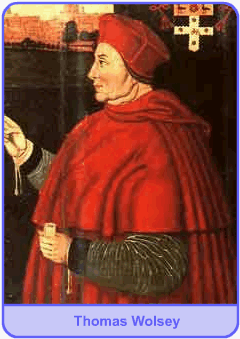
By The GroLearning Team, 22 April, 2026
Page content
Diagram - The rise and fall of Thomas Wolsey

Wolsey, born in Ipswich in 1473, was not of noble birth, but his exceptional academic abilities ensured a bright future for him.

Wolsey became a Bachelor of Arts at 15, having studied at Oxford.

He came to the attention of Elizabeth of York's brother, Thomas Grey in 1500.

In 1507 he became chaplain to Henry VII.

By 1509 he was the Dean of Lincoln, and the 'informal royal secretary'.

He went on to rise to great heights under the patronage of the King. Posts that he held throughout his reign include, Bishop of Tournai, Bishop of Lincoln, Archbishop of York, Cardinal, Lord Chancellor, Papal Legate, Bishop of Bath and Wells, Bishop of Durham and Bishop of Winchester. All of these positions brought him considerable wealth.

Although there is enormous controversy over the amount of power he yielded, there is little doubt that due to his capacity for hard work and attention to detail he made a large impact on government.

But he did not have an untarnished reputation then or since. His vast wealth was acquired, in part, because he kept bishoprics open when a bishop had died, and took the rents for himself. He had two sons, despite being a bishop, archbishop, cardinal and papal legate!

He had a close relationship with the papacy as well as with the king. He felt that he had to support the policies of the papacy, especially following his promotion to Papal Legate.

He believed in justice for all. But at the same time he persecuted the rich (was he jealous because of his low birth?).

⚠️ Image Coming Soon! - original image: 2007-10-03_134932.gif

Was he Henry's servant or the second king? There is much debate about whether he was responsible for policy making or simply carrying out the king's wishes.

Henry's relationship with Wolsey has been likened to a father - son relationship (David Starkey).

It is a mistake to call Wolsey a 'minister'. He was the king's servant, and exactly that. (John Guy) He played a major part in informing Henry about both business and people.

He ruled in an astutely political way. He would consult ministers on policy, but only after it had been formulated!

One of his major failures was the Amicable Grant, which was a kind of tax, which led to rebellion. The resistance was successful, and in order to save himself face, Henry made Wolsey the scapegoat.

Foreign Policy

He was more disposed towards a policy of peace, seeing himself as the peacemaker of Europe. He was sympathetic with the Humanistic ideas of the time which heralded peace above war. Bu this could not always be reconciled with Henry's desire for glory through military victory.

His crowning glory in foreign affairs was the Peace of London. This set the scene for England's ensuing role as the 'Peace maker of Europe'. Soon afterwards, Henry met Francis at the Field of the Cloth of Gold.

But did he want the reputation of peacemaker for himself, or for his master?

The Fall

Things began to go badly for Wolsey in 1526 when he came head to head with the nobility over the Eltham Ordinances. Faction at court was getting the better of him, and he found himself no longer being able to contain the nobles, especially since the arrival of Anne Boleyn. Not only this, but increasingly, Henry was calling the shots on policy.

"Wolsey was destroyed because he had become a liability in the eyes of the king and was expendable. This has fundamental implications for reassessing his relationship with Henry." (John Guy)

Love him...

George Cavendish: "The king displayed a most loving disposition towards him, especially as he was most earnest and readiest among all the council to advance the King's mere will and pleasure." (contemporary)

Hate him...

Prof. G. Mattingley: "an unwieldy hulk of corrupted flesh bearing perilously the supple, powerful brain, a daemonic incandescence of ambition and pride driving and lighting from within the bloated, rotting body." (historian)

Polydore Virgil: "Wolsey, with his arrogance and ambition, raised against himself the hatred of the whole people and, in his hostility towards the nobles and common folk, procured their great irritation at his vainglory. His own odiousness was truly complete, because he claimed he could undertake himself almost all public duties." (contemporary)

John Skelton:

So rygorous revelyng,

In a prelate specially;

So bold and so bragging,

And was so baselye borne;

So lordlye of his lokes,

And so dysdayneslye;

So fatte a magott,

Bred of a flesshe-flye...(contemporary)

Thomas More: "vainglorious far above all measure." (contemporary)

By The GroLearning Team, 22 April, 2026
Page content

Henry, Prince of Wales was barely eighteen when he became King of England. The crown passed peacefully from his father, Henry VII to him. In fact he had never known instability, and was very young when the Cornish Rebellion had taken place.

He was educated under the auspicious direction of his grandmother until, upon the death of his brother, Arthur, he became heir to the throne. After this point he was under the supervision of his father.

He was a handsome youth, many contemporary sources mention this. He had a strong physique, and a keen interest in almost all sports - wrestling, tennis, riding, and so on.

He liked to think of himself as a bit of an intellectual. He would flatter himself by spending much time in the company of great scholars, giving them royal patronage for their work (often in return for ego-boosting praise).

⚠️ Image Coming Soon! - original image: 2007-10-03_131818.gif

He was married to Catherine of Aragon in a marriage which was arranged in 1502. She was the widow of his brother. The two were able to marry with a dispensation from the Pope, on the basis that the marriage between Catherine and Arthur had not been consummated. Catherine made Henry happy. He relied on her political expertise in a number of situations. She ruled as governor for him when he went away to fight campaigns in France.

There is evidence that points to Henry taking firm control over some issues from very early on in his reign - especially in the sphere of foreign policy, but there is strong evidence to suggest that much of his government before 1529 was done by advisors, while he busied himself in other matters (like hunting and merry-making).

One of the first measures that was taken was the execution of his father's 'debt collectors', Epsom and Dudley. While some historians believe this to be the work of dissatisfied nobles within the household, it could be interpreted as Henry making his mark as a just King.

There is little dispute that Henry found the day - to - day routine of government very tedious. He was not an administrator like his father. This part of the job he left to councillors. Increasingly, it became the responsibility of one particular councillor, Thomas Wolsey.

⚠️ Image Coming Soon! - original image: 2007-10-03_132908.gif

Henry sought glory and honour in war. By April 1512 he had declared war on France and he had increased the number of vessels that the navy had. He added extra 3 000 men to the navy.

The young as well as the older Henry loved the pomp and ceremony of court. He strongly believed that the role of the court was to impress, in a way that the household of no nobleman could. He spent enormous amounts of money on his court. He took a real pleasure in joining in the pageantry himself, jousting and dancing.

1491 Henry born, the second son of Henry VII and Elizabeth of York.
1502 Death of Henry's elder brother, Arthur, Henry becomes heir to the throne. Betrothed to Catherine of Aragon (Arthur's widow)
1509 Henry becomes King and marries Catherine of Aragon.
1511 Henry joins the Holy League alliance against France.
1513 Defeat of the French at the Battle of the Spurs. Scots defeated at the Battle of Flodden.
1514 Wolsey becomes chief minister, cardinal and then Lord Chancellor.
1516 Mary born.
1518 Peace of London (Wolsey)
1520 Field of the Cloth of Gold (peace with France). Also makes peace with Charles V.
1521 Execution of Stafford. Henry writes a tract against Luther - the pope awards him the title of 'Defender Of the Faith'
1522 Anne Boleyn at court.
1523 Siege of Boulogne (not successful).
1525 Amicable Grant. Wolsey humiliated. Wolsey becomes cardinal to Pope Leo X.
1526 Arrival of Holbein.
1527 Henry is refused a divorce by the pope (who is now under extreme pressure from Charles V).
1528 War declared on Charles V
1529 Legatine court at Blackfriars considers the divorce case. Henry summoned to Rome. He does not go. Fall of Wolsey. Thomas More becomes Lord Chancellor. First session of the Reformation parliament. Simon Fish writes "Supplication for the Beggars".
1530 Oxford and Cambridge find in favour of the divorce. Clergy accused of praemunire.
1531 Pardon for the clergy. Convocation of Canterbury recognise Henry as the Supreme Head of the English Church.
1532 Submission of the clergy More resigns as chancellor. Thomas Cromwell becomes the King's chief minister. Anne Boleyn becomes Marchioness of Pembroke. She becomes pregnant. Henry and Francis I meet at Boulogne. A Glass of Truth published.
1533 Secret marriage of Anne and Henry by Thomas Cranmer (recently appointed Archbishop of Canterbury). Princess Elizabeth born. Truce between England and Scotland.
1534 Act of Supremacy; Succession Act; Treason Act; Act for Submission of the Clergy. Cromwell appointed Principal Secretary. Revolt in Ireland.
1535 The bishops reject papal authority. Executions of Thomas More and John Fisher for refusing the Act of Supremacy. Valor Ecclesiasticus compiled under the direction of Cromwell (now Vicar - General). Publication of the Coverdale Bible (first complete English translation).
1536 Dissolution of the Lesser monasteries begins. Death of Catherine of Aragon. Anne accused of incest and multiple adultery. Executed in May. Henry marries Jane Seymour. Last session of Reformation Parliament. Cromwell appointed Lord of the Privy Seal. Pilgrimage of Grace.
1537 Birth of Edward. Jane Seymour dies in childbirth. Rebel leaders of Pilgrimage of Grace executed.
1538 Destruction of shrines. Royal injunctions to the clergy.
1539 Six Articles Act. Act for dissolution of the larger monasteries. The country prepares for an invasion by the French or the Scottish. Cromwell starts negotiations with German princes (including a marriage treaty).
1540 Marriage of Anne of Cleves. Invasion fears subside. Cleves marriage annulled. Cromwell created Earl of Essex. Cromwell executed. Rise of the conservative faction led by Thomas Howard. Henry marries Catherine Howard. Last monastery suppressed.
1541 Catholic conspiracy to raise the north fails. Henry is crowned King of Ireland.
1542 Catherine Howard beheaded on charges of adultery. War and defeat in Scotland (Haddon Rig). Then victory at Solway Moss. 'Great Debasement' of the coinage begins.
1543 Henry allies with Charles V against France. Treaty of Greenwich, engagement of Edward and Mary Queen of Scots. Later Abandoned by the Scots. Henry marries Catherine Parr.
1544 Invasions of Scotland and France. Henry captures Boulogne. Third Succession Act places Mary and Elizabeth in line for the throne. Charles V seeks peace with France; Henry is forced to do the same.
1545 Anglo-French battles at Boulogne and naval engagements off the south coast. Sinking of the Mary Rose.
1546 Peace with France. Fall of the Howards. Henry becomes increasingly ill. Anne Askew burnt for denying transubstantiation.
1547 Execution of Surrey (son of the Duke of Norfolk). Death of Henry.
By The GroLearning Team, 22 April, 2026
Page content

Main issues of his reign

⚠️ Image Coming Soon! - original image: a-his-hen8b-dia08.gif

References

There's so much that has been written on Henry VIII. Look out for the following historians in particular (as they tend to disagree more than agree with each other, and this is good for your essays):

Scarisbrick JJ

Elton G

Starkey David

Loades DM

Smith AGR

Palmer MD

Dickens AG

Pollard AF

Randell Keith

By The GroLearning Team, 22 April, 2026
Page content

1. What was the most significant threat to Henry's reign, 1485 - 1509?

Answer

Answer outline and marking scheme for question: 1

As with any essay question in history you must answer using the three-step process, which should be very familiar to you.

Always make your introductions short and punchy. Make your conclusions straightforward and very convincing in the light of the evidence that you have provided.

It's the discussion section that needs the most thought and planning.

To brainstorm your answer to this question, try to use the Diamond-9 grid. This grid is excellent for trying to evaluate issues or events in an order of importance, as in this case.

But first you need to come up with a list of threats to his reign:

  • Perkin Warbeck
  • Lambert Simnel
  • Former Yorkist supporters
  • Burgundy
  • Scotland
  • The Cornish rising

The next step is to make sure that you substantiate your ideas with evidence. For this reason, try using the following table to plan your paragraphs

⚠️ Image Coming Soon! - original image: a-his-henry7-dia07.gif