GCSE & A-Level Revision Resources

By The GroLearning Team, 22 April, 2026
Page content

Never copy word for word from you article or text.

At A level you need to be able to interact with your information. You have to make your reading work for your purposes.

As explained in the Reading Skills Learn It, most of your reading will involve an investigation of some sort. You need to develop a way of making notes which will allow you to collate information (organise it in to sections), and which will allow you to add your own ideas (analyse).

Here's a suggestion:

⚠️ Image Coming Soon! - original image: 2007-10-08_153951.gif

As you can see, I have allowed myself space in-between the information to add extra information from my further reading. I have also left space at the sides, so that as I read through my notes I will be able to annotate it with my own ideas and make links.

There are plenty of other formats for making notes you may want to try some of these:

⚠️ Image Coming Soon! - original image: 2007-10-08_154223.gif
⚠️ Image Coming Soon! - original image: 2007-10-08_154234.gif

  • Bullet point
  • Your Ideas
  • Develop your own style of writing (yr, Eng)
⚠️ Image Coming Soon! - original image: 2007-10-08_154310.gif

Whether your file is for coursework or for an examination, you will make your life a lot easier if you organise your files.

The best A level files are clearly split into sections using dividers. Stuck to the front of each divider you could have a contents list. Make sure that your essays and essay plans are included in the body of your notes and not stuck at the back of your file, where you will never touch them again. It's worthwhile, once in a while, giving yourself time to check through your files to make sure that you are up-to-date, and organised.

The worst organisation I ever saw consisted of a student who was the proud owner of a large black bin liner full of his notes. In his mind he felt he was organised but in reality he had no clue where anything was, when exams came it took him twice as long to revise the relevant information than anyone else. To cap it all, the week before the final exam he mistook the bin liner for rubbish and ended up throwing all his notes away.

Needless to say, the boy didn't do too well in his exams and failed three out of six of his exams; he was never the same again.
By The GroLearning Team, 22 April, 2026
Page content

You may well think that learning to read is a skill accomplished in primary school. And you are right, to an extent. But, with the amount of literature that an A level history student is faced with, if you read like you were taught to read at primary school you will either, a) be up all night working and rapidly begin to hate the subject, or b) have a nervous breakdown. It is the A level that involves the most reading, and the competent history student must learn how to read selectively.

So, here's a few tips:.

Don't read every word. You are often reading for a particular purpose. You might have been set a task to make notes on Jansenism in Seventeenth century Europe. You will not pick up Cowie's 'Seventeenth Century Europe' and embark upon reading it cover to cover. What you should do is check the contents, and then narrow down the search by looking in the index.

You may be looking for a certain topic, or issue. It would be worthwhile at this point jotting down a few questions about the topic, or a list of key words that you would like to know more about.

You still do not read every word. There are various methods you can use...

Skim the paragraphs, and read in detail the parts of the paragraphs that you find relate in detail to your topic.

Top and tail. Most paragraphs start and end with statements, and the middle parts explain the issue or provide evidence. If you have done a fair bit of reading on the issue, and you are really just after opinions, this is an excellent way to read. This can be used for whole articles, if you are not sure that you are going to gain anything new from (yet) another source.

Always start your reading with the easiest textbook that you can get your hands on, and gradually work your way up to the more complicated stuff. This way you will become more confident about the terms that are used and the main issues.

Beware

Highlighter pens.

They are great, but only when used to highlight specific points. Some handouts that students are given by their teachers can look like colour-by-numbers when they are brought back to lessons!

Not doing the reading / reading the bare minimum. Your teacher will be able to tell.

By The GroLearning Team, 22 April, 2026
Page content

Don't read every word - skim, scan, top and tail the text.

Start with the easiest texts first, and work your way up to the harder material.

Don't 'colour in'!

Don't copy word for word.

Leave spaces for your own ideas.

Collate your reading.

Make sure your file is well organised and check through it at regular intervals.

Make contents lists for your files.

Unpack the question.

Plan the discussion well, making sure that your points are fully explained and that evidence is provided.

Make sure that your conclusion is the culmination of your argument.

Assess your own work against a mark scheme.

Keep a record of ways to improve next time.

Avoid narratives.

Chose your question - making sure that it is focused, and that it will mean that you will have to argue a point in your answer.

Keep a separate file of notes.

Be adventurous with your research.

Organise the writing into clear sections, use headings.

Make sure that all the information is properly referenced.

Unpack the questions.

Note the mark allocation.

Always refer to the documents that are mentioned in the question.

Use key words like author, motive, audience, propaganda, limitations...

Quote historians in your written work.

Try to demonstrate that you are aware of the main issues.

Show how historians agree and how some disagree on an issue.

Make sure you learn the information, and don't just recognise it.

Use timelines, tables, spider diagrams, and other diagrams.

Practise at home under timed conditions.

By The GroLearning Team, 22 April, 2026
Page content

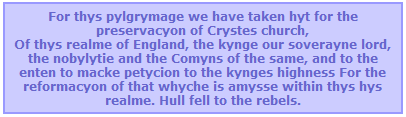
1. Read this source, and then answer the questions that follow.

Alacke! Alacke!

For the church sake

Pore commons wake,

And no marvell!

For clere it is

The decay of this

How the pore shall mys

No tong can tell

For ther they hadde

Boith ale and breyde

At tyme of nede,

And succer grete

In alle distresse

And hevyness

And well intrete

Crim, crame, and riche

With ther ell and the liche

As sum men teache

God theym amend!

And that Aske may,

Without delay,

Here make a stay

And well to end.

(Extracts from a ballad probably composed at Sawley Abbey, 1536.)

1. Briefly explain the reference, 'For the church sake, Pore commons wake'.

(3 marks)

2. What reasons are given in this ballad for the commons to rise?

(6 marks)

3. Why do historians give different reasons for the Pilgrimage of Grace, to those given here?

(9 marks)

(Marks available: 18)

Answer

Answer outline and marking scheme for question: 1

1. In your answer you should have shown that you know that this is a ballad written in the time of the Pilgrimage of Grace, and explain this rising in a limited way. You should also mention that it is a call to the commons to rise to protest, even stop further dissolution of the monasteries.

(3 marks)

2. You are required here to list the reasons given in the source and no more than this. You should have mentioned:

Their concern for how dissolution will affect the poor: in terms of bread and ale (!) (but in a time when people drank more ale than water we must remember). There is a reference further down the ballad that refers to reformist religious teachings, 'God theym amend!'

(6 marks)

3. It would be helpful if you could demonstrate an awareness of where historians stand on this issue.

Some ideas to include in your answer:

Perspective: historians are able to see the whole picture more clearly than contemporaries were, in part because of their access to sources. They are more able to put events in their national as well as local context.

This source is emotive. It is designed to stir the commons. It is a piece of propaganda.

(9 marks)

(Marks available: 18)

By The GroLearning Team, 22 April, 2026
Page content

  • Oath taking takes place in Dent and the West Riding of Yorkshire.
  • Late 1536 three government commissioners dissolving smaller monasteries were working in the Lincolnshire area.
  • Rumours fly that the people are going to be taxed heavily on things like horned cattle, baptisms and marriages.
  • 3rd Oct. the commons of Louth march on the town to meet the commissioners. They believe that their weapons are about to be confiscated.
  • Captain Cobbler leads them.
  • The rebels went on to a nearby nunnery.
  • 4th Oct. gentry join in.
  • A manifesto is written.
  • The Bishop of Lincoln's registrar is murdered.
  • The rebels march to Lincoln. A new set of articles is drawn up.
  • Henry sends Suffolk to Stamford to be on standby.
  • Rebels march with a banner which shows the five wounds of Christ.
  • 8th Oct. Robert Aske calls upon the people of Beverley to be true to 'God, the king, the commonwealth and to maintain the Holy Church'.
  • 10th Oct. the West Riding of Yorkshire is called to rebellion by the ringing of church bells.
  • 13th Oct. while marching to York, Robert Aske begins to speak of their campaign in terms of a 'pilgrimage'.
  • 16th Oct. the rebels led by Aske reached York.
  • He gives the mayor a list of grievances, among which were:
  • Suppression of the religious houses.
  • Act of Uses - people had liberties taken from them because of this act which enquired into land value.
  • Tax on sheep and cattle was unfair - the commons were already in a state of poverty.
  • The low birth of most of the councillors who rule only for their own profits, like Richard Rich and Cromwell.
  • Reforming bishops were not popular.
  • He also made this declaration:
Diagram - The Pilgrimage of Grace

  • From the 16th - 23rd Oct. a number of important Yorkshire cities and towns gave in to the rebels, including, Richmond, Sedburgh and Nidderdale.
  • 21st Oct. Skipton castle was under siege.
  • In this time the king disbanded his army thinking that it was no longer needed.
  • The rebels went to Pontefract castle to try to secure support of the nobility.
  • The Duke of Norfolk meets with the rebels at the River Don.
  • Some Yorkshire nobles go to London to petition the king.
  • 2nd Nov. the king promises to pardon all but the ten ringleaders. He says that he will receive the rebels in London and consider their case further.
  • 2nd Dec. the promise of a pardon is repeated and Henry promises a free parliament.
  • Aske relays these messages back to the rebels at Pontefract. They are disbelieving and threaten to rise again.
  • After Christmas there is a second rising in Yorkshire, as many see the king's promises going unheeded. This is led by Sir Francis Bigod. Aske tried to warn off Bigod.
  • The Duke of Norfolk declared martial law in the West Marches.
  • The rebels were all hanged in Carlisle, except for Aske who was executed at Clifford's Tower in York.

  • Focus your further reading/revision around these possible causes of the Pilgrimage of Grace
  • A protest against the dissolution of the monasteries on religious grounds.
  • A protest against the dissolution of the monasteries on economic grounds.
  • A protest against Cromwell more than Henry.
  • A commons led revolt focussing on dissolution.
  • A gentry led revolt.
  • A revolt driven by economic and social grievances with very little to do with the dissolution.
  • A spontaneous or a well-planned outbreak?
  • A revolt spurred by the nobles' dislike of the Reformers in government (led by the remnants of the Aragonese faction).

Here's a list of historians who have conflicting views on the rebellion:

Elton GR, Reform and Reformation in England

Scarisbrick JJ, Henry VIII

Loades DM, Politics and the Nation 1450-1660

Fletcher A, Tudor Rebellions

By The GroLearning Team, 22 April, 2026
Page content

Religious: To committed Protestants the monasteries were a reminder of the power and the practises of the Catholic Church.

Religious and Political: The monasteries owed their affiliation to the Pope in Rome, not to Henry. Henry was trying to assert himself as supreme Head of the church in England.

Religious: the houses were associated with Papist practises such as praying for the dead. The Reformers were moving away from the idea of purgatory, and so these prayers were rendered unnecessary.

Financial: The king was in need to meet the expenses of government.

Financial: It was a period of inflation which meant that money was not worth what it once was. Henry could not survive off crown rents and loans alone.

Financial: Cromwell wanted to use monastic lands as an endowment off which the monarchy could feed forever. (Palmer)

Financial: Henry wanted extra money without taxing the people.

Financial and Foreign Affairs: Henry needed money to put down the Geraldine Rebellion in Ireland.

Continuation: It was nothing new. Cromwell had helped Wolsey dissolve monasteries.

Religious: A number of lay people protested against the corruption of some of the (especially smaller) monasteries.

Economic: The gentry and nobility were eager to buy more land.

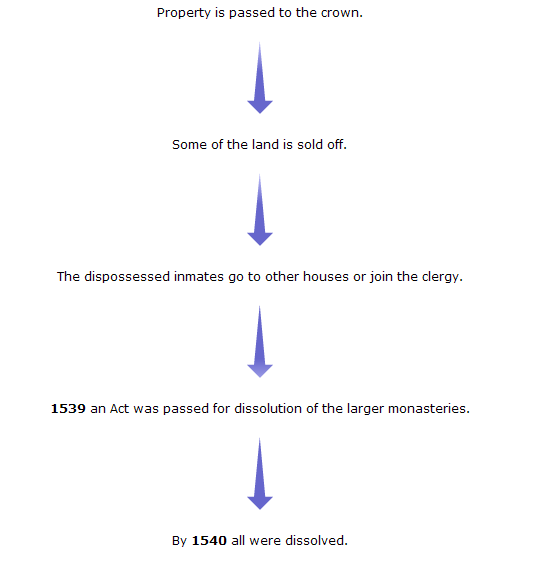
Diagram - The Dissolution of the Monasteries

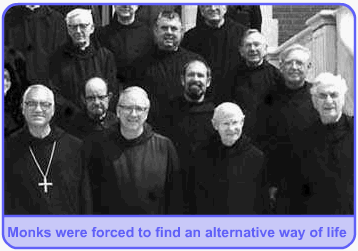
9 000 religious monks and nuns were forced to find an alternative way of life.

Diagram - The Dissolution of the Monasteries

The government had to pay out a large sum of money for some of these dispossessed persons.

The immediate area around the monastery may have suffered from the absence of monastic charity.

The monasteries provided the crown with over a million pounds.

The lay estates profited.

The sale of monastic estates gave the purchasers a considerable vested interest in the Reformation and this was one aspect of religious change that even Mary Tudor dared not alter. (Palmer)

Due to the purchasing of land, the influence of the squire was increased in the parish.

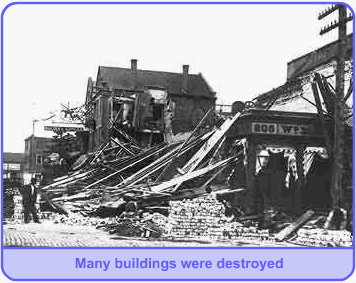
There was the loss of many buildings.

Diagram - The Dissolution of the Monasteries

Priceless Medieval art was melted down, and disappeared forever. There was a loss to scholarship as the libraries disappeared also.

The dissolution of the lesser monasteries was a cause of rebellion - the Pilgrimage of Grace, 1536.

Scarisbrick: He thinks Henry had planned the dissolution of the larger monasteries all along, and it was not an after thought. In his evidence he comments on the advice that Henry gave to the Scots on dissolving the monasteries, stating that you must be secretive at first.

Palmer: "It was possible for large parts of England not to have noticed the political Reformation, but few would have failed to be touched by some aspect of the dissolution of the monasteries."

He believes that the motive for dissolution was financial.

Elton: He says that the dissolution of the monasteries has been over-emphasised. He says that although it was spectacular, it was not the central part of the Reformation. He believes that monasticism in England was already on its last legs.

He says that the MPs wanted the land.

He also maintains that the land of the monasteries had been under attack for two centuries.

Guy: he believes that they had to go because they could not operate alongside supremacy. He implies that there were more intellectual origins to the dissolution.

By The GroLearning Team, 22 April, 2026
Page content


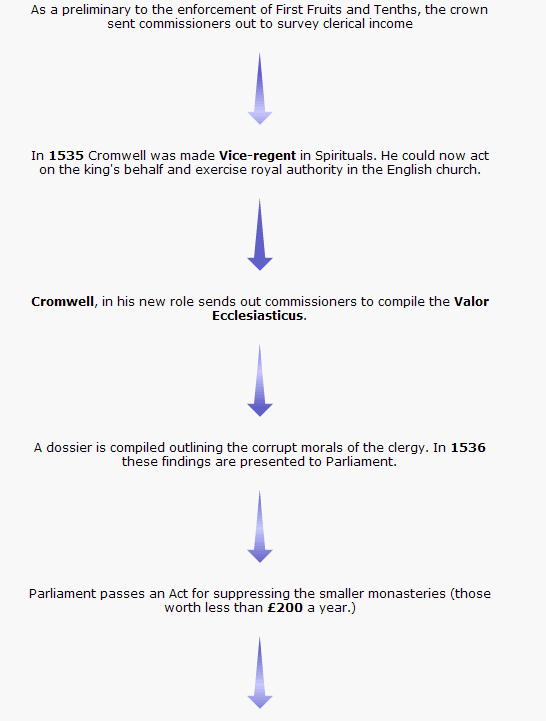
Act in Restraint of Appeals, 1533Put a stop to all appeals in testamentary (wills), matrimony and tithes going to Rome. These cases would now be heard in ecclesiastical courts in England.
Act of Supremacy, 1533 Confirmation of Henry as Head of the Catholic Church in England and Wales.
Act in Restraint of Annates, 1534This Act disallowed the payments of 'First Fruits and Tenths' from going to Rome. They would go to the crown instead. It also laid down the procedure for the election of bishops and abbots. A later Act abolished 'Peter's Pence'.
Succession Act, 1534This put the heirs of Henry and Anne above all others. To question this became a treasonable offence. Every adult in the land had to swear an oath agreeing to this.
Act for the Submission of the Clergy, 1534 This took away the right for the Convocation to assemble without a royal licence.
Treason Act, 1535 This was a formidable piece of legislation which made it an offence to desire in any way harm to the king, the queen or the heir apparent. This, if used frequently would have given Henry something very close to absolute power.
Act Extinguishing the Authority of the Bishop of Rome, 1536Just in case anything had been missed, this made sure that any loopholes were dealt with. From this point onwards, Henry could be sure that complete control of the church was his.
By The GroLearning Team, 22 April, 2026
Page content

Why Henry broke with Rome is a cause of great controversy in Tudor history.

Whether this constituted a 'Reformation' is also a major historical hot potato. Here's what some historians have to say on the matter

In 1964 he wrote his The English Reformation which deliberately set out to explain and document how the Reformation was influenced, to a large extent, by the upsurges of support for the new Protestant ideas. He maintained that Lollardy had survived as a kind of underground movement.

He criticises Dickens saying that Dickens set out with a point to prove, and that in some way makes his research and conclusions invalid. He points to evidence that many English people were still attached to Catholicism.

Along with Haigh, he holds the view that the Reformation took a long time to take hold, right up to Elizabeth's reign.

"On the whole the, English men and women did not want the Reformation and most of them were slow to accept it when it came."

He holds the revisionist view that the Reformation was in no way inevitable. He maintains that there was not one 'English Reformation', but as series of political accidents, which if put together look like a Reformation.

In his book, The Blind Devotion of the People, he looks at the reactions of Devon and Cornwall to the religious changes that took place in the sixteenth century. He sees the Reformation in these areas as a very slow process, and in the final analysis some still clung to the old ways. Nevertheless, he sees the pre-Reformation church in a state of decline. From 1530 -1550 he sees an almost complete acceptance of the changes with people more content to keep their hard earned money in their pockets rather than give it to the church.

He maintains that grassroots change in religion was a result of the Reformation imposed from above. But the change was not radical, it didn't even take root under the reign of Edward VI.

"The Reformation in England was in two parts. Henry VIII achieved a political revolution in the government of the Church by instituting an autonomous English Church with himself as supreme head between 1533 and 1534. The movement for religious reformation also made slight headway while he was alive, but it took root during his son's reign."

By The GroLearning Team, 22 April, 2026
Page content

Was the reformation imposed from above on an unwilling indifferent country or was it initiated from below and all that Henry had to do was channel this dissatisfaction for his own ends?

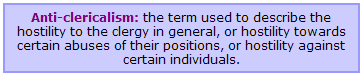
Diagram - Anti-clericalism

In 1512 John Colet, the Dean of St Paul's, preached the opening sermon to a meeting of the Convocation of Canterbury. In this speech he emphasised the need for reform and blamed the current state on the clergy.

In 1529, before the opening of the Parliament, Simon Fish, a Lutheran and lawyer, wrote a pamphlet A Supplication for the Beggars, which was strongly anti-clerical.

In the early c16th it was very generously staffed.

Many entered the profession because it was the only profession they could enter. Modern comparison would be teaching or the civil service.

Colet and Fish both agreed that there was too much:

  • Pluralism
  • Non-residence
  • Nepotism
  • Simony (buying or selling of church benefits. Like pardons or relics).
The Lollards had been criticising the Church for many years.

Humanists believed in the central importance of the Humanities.

That is to say that they believed in the importance of the study of the classics as well as the Bible, i.e. Plato and other philosophers.

The movement was inspired by Erasmus the Dutch scholar. He campaigned for reforms in the church.

Humanists believed that the church should be much simpler and based more on the Bible.

Diagram - Anti-clericalism

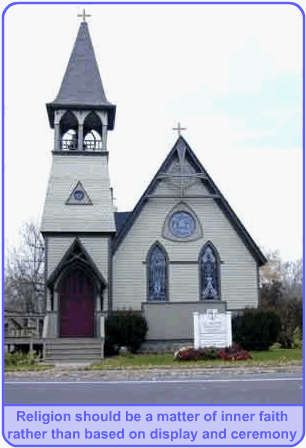
They believed that religion should be a matter of inner faith rather than based on display and ceremony.

People who followed this line of thinking were also known as Erasmians. Including: Colet, Sir Thomas More and John Fisher, the Bishop of Rochester. But they stopped short of challenging the doctrine of the church.

There were others like Simon Fish who believed that the church would have to be reformed by the King because it was beyond reforming itself.

There were also the heretics like the Lollards who had held many of the ideas of Martin Luther before his protest. For example, they attacked the notion of the priest as the intermediary between the layman and God. These groups were never influential and historians debate their strength.

By 1519 his books were in England. They came over via the East of the country through those that traded with Germany.

Cambridge academics would meet in the White Horse Inn to discuss these new ideas.

In 1525 Tyndale produced a version of the Bible in English rather than Latin (New Testament). It was very successful and it ran to several editions.

Lutherans had few supporters in England. They were not really a challenge to the church.

Records of visitations show that many of the Bishops were carrying out their duties conscientiously.

The clergy were not always the fumbling ignorant hypocrites that they are portrayed to be by many. They might not have been in touch with all of the latest ideas but they would have had some conventional training.

The clergy were criticised for being over efficient!

Look at wills. Many leave money and goods to be used for religious purposes. There are bequests to orders of friars and nuns. Money is left for the praying of mass when they are dead.

There was a lot of church building in this period, and most of this was paid by the parishioners themselves.

There are a number of books published in the period which focus on piousness.

"All this indicates a people co-operating with the clergy in maintaining a Church that satisfied their needs. Far from the laity and clergy being at odds they are seen acting in partnership." (Scarisbrick)

By The GroLearning Team, 22 April, 2026
Page content

It was not uncommon for kings and princes to divorce. Papal decrees were granted for these, so Henry's case was not a precedent.

His marriage to Catherine had produced no male heirs, and he took this as a judgement from God that his marriage went against Divine Law. He should not have married his brother's widow. There is evidence that he was feeling this way before Anne Boleyn came onto the scene.

Henry openly declared that he and Catherine were therefore having an adulterous relationship, and he must remedy this situation immediately.

He quoted Leviticus, 20:21, in order to demonstrate God's judgement against him, "If a man marries his brother's wife, they shall die childless. He has done a ritually unclean thing and has disgraced his brother." Conveniently forgetting that they had a daughter.

There was a rebuff to this in Deuteronomy 25:5, "If two brothers live on the same property and one of them dies, leaving no son, then his widow is not to be married to someone on the outside of his family; it is the duty of the dead man's brother to marry her."

Another problem was that Catherine maintained that her marriage to Arthur had not been consummated. This could well have been the case as the two were married while very young. For Henry's purposes it was important that Catherine had been fully married to his brother.

The Papacy felt it would be hypocritical to move on this issue as Pope Julius II had given the dispensation to marry in 1509. The Pope was supposed to be infallible, and Clement felt that he was unable to contradict his predecessor.

⚠️ Image Coming Soon! - original image: 2007-10-03_171930.gif
⚠️ Image Coming Soon! - original image: 2007-10-03_172007.gif
⚠️ Image Coming Soon! - original image: 2007-10-03_172029.gif