
WHAT YOU'LL LEARN
Hyperinflation and the Crisis of 1923
Germany in 1923 was being torn apart. The currency was worthless, French troops had marched into Germany's industrial heartland, and ordinary people were watching their life savings evaporate in weeks. How did the country end up here – and what did that crisis make possible for those who wanted to destroy the Weimar Republic entirely?
What were the reparations – and why did they create a crisis?
What does a country owe when it loses a war? In 1919, the victorious Allied powers decided: a great deal.
The Treaty of Versailles had assigned Germany sole responsibility for causing the First World War under the War Guilt Clause (Article 231). That legal fiction created the basis for demanding compensation. In 1921, the Reparations Commission set the final bill at £6.6 billion – a sum so large that Germany was not expected to finish paying it until the 1980s.
The Weimar government faced an impossible situation. The war had already devastated the German economy: factories had been converted to war production, the merchant fleet had been seized, and the Allied naval blockade had caused widespread malnutrition. Tax revenues were low, government spending was high, and the new democracy had to buy political support from a population that had just endured four years of sacrifice.
To cover its costs, the government began printing money. As long as Germany met its reparations payments and kept borrowing, the inflation remained manageable. But when Germany fell behind on its timber and coal deliveries in late 1922, the Allied powers lost patience – and France acted.
Why did France occupy the Ruhr – and what followed?
Key term
The Ruhr
The Ruhr Valley, in the west of Germany, was the country's industrial heartland: coal mines, steel works, and factories that produced the majority of German heavy industry. Controlling the Ruhr meant controlling Germany's capacity to produce. When France and Belgium occupied it in January 1923, they were not simply making a political point – they were seizing the economic engine of the country.
In January 1923, French and Belgian troops marched into the Ruhr. Their justification was simple: Germany had defaulted on reparations deliveries, and the Ruhr's coal and steel would be taken directly as payment.
The German government, led by President Friedrich Ebert, responded by ordering passive resistance: workers in the Ruhr went on strike, refusing to cooperate with the occupying forces. Factories shut down. Trains stopped running. The strategy was nationally popular – refusing to collaborate with France felt like a point of dignity. But it came at an enormous cost.
Key concept
Passive resistance
Passive resistance meant refusing to cooperate with the French occupation without using violence. Workers went on strike, civil servants ignored French orders, and the German government paid the wages of all workers who downed tools. The moral case was strong: Germany was resisting an illegal invasion. The economic consequences were catastrophic: the government had to print vast amounts of money to pay millions of idle workers, and it had no industrial output to back up that new currency. Passive resistance was the immediate trigger for the hyperinflation spiral.
To pay millions of striking workers, the German government printed more and more money. It had nothing of real value to back the new currency up. Inflation, which had already been rising, now became hyperinflation – a spiral so extreme that it destroyed the value of the currency faster than prices could be printed.
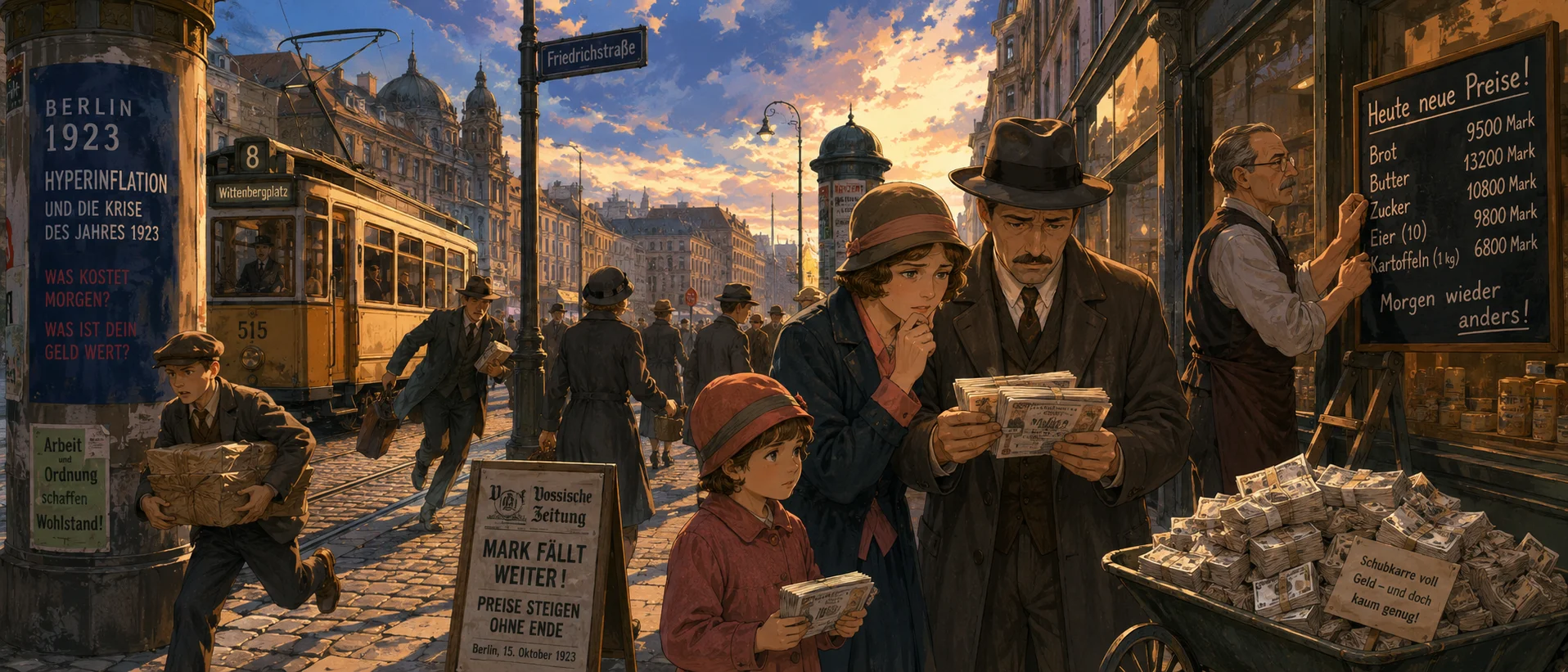
By late 1923, the German mark was essentially worthless. The exchange rate that had been 4.2 marks to the dollar in 1914 reached 4.2 trillion marks to the dollar by November 1923. Workers were paid twice a day so they could spend their wages before lunch made them worthless. Shopkeepers changed prices by the hour. Wheelbarrows of banknotes bought a loaf of bread.
Who did hyperinflation hurt – and who did it help?
Hyperinflation did not destroy everyone equally. For those living on fixed incomes – pensioners, people with savings, creditors who were owed money – the crisis was devastating. A pension that had once covered living expenses now bought almost nothing. A lifetime of savings was wiped out in months. The German middle class, which had sacrificed during the war and expected stability after it, found itself suddenly destitute.
For some, however, the situation was different. Those with debts benefited: as the currency collapsed, their debts became worthless too. Landowners, factory owners, and others with real assets – property, machinery, foreign currency – found that their wealth survived. The crisis sharpened inequality and created bitter resentment, particularly among the middle classes who had lost savings rather than land.
Political extremists on both left and right saw opportunity in the chaos. In November 1923, at the height of the crisis, Adolf Hitler and the Nazi Party attempted to seize power in Bavaria in what became known as the Munich Putsch – calculating that the Weimar Republic was too weak to resist. They were wrong, but the attempt signalled how dangerous the crisis had become.
How did Germany escape the crisis?
Key individual
Gustav Stresemann (Chancellor, then Foreign Minister, 1923–1929)
Stresemann became Chancellor in August 1923 and made two decisive moves. First, he ended passive resistance in the Ruhr – an unpopular decision that accepted Germany could not win the standoff with France but would at least stop the economic bleeding. Second, he oversaw the introduction of the Rentenmark in November 1923, a new currency backed by land and industrial assets rather than empty promises. His short chancellorship stabilised Germany enough to allow the longer recovery that followed. Stresemann served as Foreign Minister from November 1923 until his death in October 1929.
In August 1923, Gustav Stresemann became Chancellor. He faced two urgent tasks: end the Ruhr occupation and stop the currency collapse.
Ending passive resistance was politically painful. Many Germans felt it was a surrender. But Stresemann understood that Germany could not sustain the cost of paying millions of idle workers indefinitely, and that continuing to print money would only deepen the disaster. He called off the resistance in September 1923, and negotiations with France began.
In November 1923, the Rentenmark was introduced to replace the worthless mark. Crucially, it was backed by a mortgage on Germany's land and industrial assets – something of real value. Germans were asked to trust the new currency, and, slowly, they did.
The following year brought further relief. The Dawes Plan of 1924, negotiated with the United States, restructured Germany's reparations into manageable annual payments and unlocked American loans to German industry. The immediate crisis was over. Whether the recovery that followed would last was another question.
The examiner's test: A student who lists the Ruhr, hyperinflation, and the Rentenmark has the facts. A student who explains the chain of cause and consequence – reparations defaulted → Ruhr occupied → passive resistance ordered → money printed → hyperinflation → political extremism → Stresemann's rescue – has the analysis. That chain is what the 8-mark "explain why" questions are asking for.
Summary Card
If you remember three things about the crisis of 1923, remember these.
- Germany's hyperinflation crisis began with reparations and was triggered by the French occupation of the Ruhr in January 1923. When the German government ordered passive resistance and printed money to pay striking workers, the currency collapsed. By November 1923, the exchange rate had reached 4.2 trillion marks to the dollar. In your exam, specific details – the £6.6 billion reparations bill, the January 1923 occupation – turn vague answers into strong ones.
- Hyperinflation hit the middle class hardest – destroying savings and pensions – while those with land and assets survived. This created lasting bitterness that the Nazis would later exploit. Understanding who lost out in 1923 helps explain who was willing to vote for extremist parties in 1932. The consequences of hyperinflation outlasted the crisis itself by a decade.
- Stresemann ended the crisis by making an unpopular decision: calling off passive resistance and introducing the Rentenmark. The Dawes Plan of 1924 provided the American loans that made recovery possible. Stresemann's willingness to act pragmatically rather than popularily is why the late 1920s became, briefly, a period of stability.
Memory hook: Reparations → Ruhr → Hyperinflation → Rentenmark. Four words map the whole crisis.
Revision checklist
Before moving on, make sure you can answer:
- Why were reparations so economically damaging to Weimar Germany, and what was the total figure set in 1921?
- Why did France occupy the Ruhr in January 1923 – and what did the German government do in response?
- What was hyperinflation, and which groups in German society were most badly affected?
- What was the Rentenmark, and why did it help end the crisis?
- How did the crisis of 1923 create political opportunities for extremists like Hitler?