There are a number of factors why this rebellion failed. In your answer you should consider them all. Here are a few ideas. (Try to find evidence to substantiate them.)
Lack of coherent leadership.
Lack of aristocratic support.
Failure of the other three counties to rise.
Wyatt's own personal shortcomings.
Because the rebels delayed in attacking London.
The strength of Mary's support (especially after her speech to Londoners).
This is a really interesting question, and it gives you an opportunity to show off the amount of historiography that you know about the issue.
2. In what ways, if any, was Edward Seymour a 'good Duke'?
Here's your ideal opportunity to show off your historical awareness about how Somerset has been treated by historians in the past. If you cannot remember go back to the section on Somerset.
You could also define what exactly you think a 'good duke' was in the Tudor period. (If you can, try to show how contemporary perceptions of good leadership might have influenced historians who were writing in the nineteenth century, the early twentieth, the 60s, the 80s, and so on. This would take you up into the top band of the mark scheme showing that you can critically evaluate the ideas of historians.)
Discussion
Remember to demonstrate a balance here. It is important that you can find examples of him being a 'good duke' and examples of him not being such a good duke.
Conclusion
Sum up the main points of your argument and present your answer (that should have shown throughout your argument/discussion). There is also an opportunity to compare him to Northumberland (if you want).
For more information on structuring essays and how to use historiography go to the skills section.
Henry VIII's Will was upheld. The succession went according to statute law.
All of the rebellions were quashed easily. They were all localised. Not one of them threatened the Kingdom like the two Northern risings (1536 and 1569).
The system of government did not break down - there was no revolution.
Ideas about a 'social' crisis pertain to the whole of the Tudor period.
The cloth market recovered from the Antwerp crash.
There's no constant economic crisis that spans the full period from 1547 - 1558.
The second part of Mary's reign is fairly peaceful.
Many factors were out of the monarchs' control, so if there were crises they weren't of their doing.
Historians have fabricated the idea of a mid-Tudor Crisis.
There were bigger crises in other Tudor periods, like in 1594-5 and 1527.
The period has been ignored for a long time, and it is only in the past decade that historians have started to research the period in depth. Perhaps we need to look more carefully at the original sources to get the real picture.
Two factors governed foreign policy in the years 1553-1558.
Philip of Spain's wishes.
Return to Rome.
The council was afraid that the marriage would mean that England became embroiled in Spain's affairs on the continent. Philip was forced to make assurances that this would not happen. But it did.
The Loss of Calais:
Philip needed English men and resources to continue his war with the French. The council (except for Stafford) opposed this wholeheartedly.
But then a bizarre incident happened which made war with France inevitable. Thomas Stafford, an exile, landed in Scarborough, took the castle there and proclaimed himself 'Protector of England'. He had the backing of the French.
The Anglo-French war went on for a year. England lost. Worse than anything, they lost Calais, the last English foothold on the continent. Mary could not live this down. Her reign has traditionally been regarded as the end of a period of glorious warfare (although this isn't exactly true).
Mary could only re-catholicise England through statute law.
In the first Parliament of October 1553 the First Statute of Repeal was passed. This repealed most of the religious legislation passed during Edward VI's rule.
By 1554 the tone of her counter reformation had changed. The second Statute of Repeal was passed, this undid most of the Henrician religious reforms. Although Mary did not dare to touch the church lands that had been sold in the 1530s and 1540s.
A new Treason's Act was introduced which gave Cardinal Pole and Mary the power to persecute 'heretics' on a large scale.
Cardinal Pole was the Queen's cousin. He had spent the past twenty or so years in exile in Rome. He nearly became Pope, narrowly missing the election by one vote.
Mary called him back from Rome in late 1554. He came from Rome with absolution for the whole realm. Upon his return to England he told parliament of his intentions: "My commission is not to pull down but to build: to reconcile, not to censure; to invite but without compulsion."
He presided over the Legatine Synod in London in 1555-56, which dealt with matters such as:
Obedience to Rome.
The restoration of respect for Papal canon and Papal law.
The revival of Catholic ceremonies.
The non-residence of bishops.
Preaching.
It was decided that all bishops should be resident in their sees, and there was an emphasis on the role of preaching. Not all of the services were reverted to Latin; the vernacular was kept in some cases.
The mistake that he and Mary made was that it was going to be easy to 'reconcile' the people to the Catholic church. It wasn't.
In all 300 'heretics' were burnt between February 1555 and the end of Mary's reign in 1558. Most of the victims came from the South East of England, especially Essex (52) and Kent (59). There were only 3 burnings in Wales and only 1 in the north. The accused were burnt as this was the traditional heretics execution, the flames represented purification.
Latimer and Ridley were burnt in Oxford on 26th October 1555. Cranmer was burnt on 21st March 1556. (Pole had become Archbishop of Canterbury.)
Simon Renard, Philip's ambassador wrote to him in 1555, "The people of this town of London are murmuring about the cruel enforcement of the recent acts of parliament on heresy." He informed Philip of how the people who watched the burnings wept openly, collecting the ashes and bones of the victims. (The Privy Council tried to limit the number of people who attended the burnings.)
Many of these victims have enjoyed the reputation as 'martyrs' since John Foxe's publication of Acts and Monuments in the reign of Elizabeth. The impact of the burnings may have been exaggerated in the past. One account states that the smell of burning flesh was no stranger to the streets of London. In fact, the burnings in London took place, on the whole, in Smithfields, and there were 46 in total. Nevertheless, 300 human lives were lost (men, women and teenagers) in less than 3 years.
England was not 'Protestant' on the 6th July 1553 and Catholic on the 7th. It could never be that simple.
It is difficult to measure the extent of the Henrician and Edwardian reforms, and the extent to which England was 'Protestant' on the eve of Edward's death. There is evidence, which Jennifer Loach uses, that demonstrates a considerable amount of support for the new Queen, and an anticipation of the Catholic reforms to follow: In Chester-le-Street there was a spontaneous restoration of the Latin Mass, in Melton Mowbray the altar stones were 'back in place before mass was said for the dead king', and hidden images of the Virgin Mary and other saints re-emerged quickly (even in the so-called Protestant areas of the South East).
The same issue is raised at the end of her reign: was England firmly on its way to Catholicism once more in 1558? Possibly not. It's more likely that people anticipated change again under the new Queen. There are wills which have enlightening clauses, like that of a York parishioner, who when bequeathing a vestement to his local church, he included the proviso that 'if the use of vestements do cease in churches' then it should go back to his family. In another instance, a man from Kent who donated money in his will added that the money should go to the poor if the law was changed again. (Both examples come from Jennifer Loach's article, Mary Tudor and the Re-Catholicisation of England, History Today 1994, which you can buy online at the website of History Today.) People were uncertain of the future.
The burnings were probably unpopular, but after Wyatt's rebellion, there were no other serious threats to Mary's reign. And it is important to remember that the heretics had to be tried by local jurors before they were prosecuted, so there must have been some local support for the policies.
Towne best sums up the situation: "If England was far from being a Protestant state in 1553, it was also far from being universally Catholic in 1558."
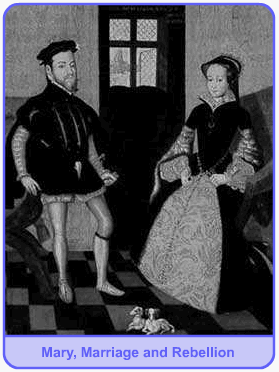
Mary was decided on marriage once she was securely Queen of England. She had not married in the years before for fear that this may stand in her way of claiming the throne. All this despite her being 37.
There were 3 main contenders for her hand. These were:
Reginald Pole (who himself had a claim to the throne. He was in Rome, but as yet had not been ordained).
Edward Courtenay (an English nobleman, a descendant of Edward IV, who had been incarcerated under Henry's reign. His father had been executed for his adherence to the 'old ways').
Prince Philip of Spain (who was strongly encouraged by his father, the Holy Roman Emperor, who in turn was Mary's nephew).
For various reasons Mary decided on Philip. Pole wasn't really an option, although Mary was very fond of him, and Courtenay, in spite of his good looks and support from Gardiner, had no political and inter-personal skills. So Philip it was. He was already a prince, with extensive experience in government, he had money, his father was a close ally of Mary's (whom she had relied on for advice in the past). The council agreed the match, and the marriage was approved by Parliament in its second sitting in April 1554. Many courtiers feared that Philip would want to be called King of England, and as such exercise royal prerogatives. They feared that their positions at court would be compromised by an influx of foreign favourites.
As a result of these fears, the council attached a number of conditions to the Marriage Treaty:
England's laws must be respected in every respect.
No foreigner would be allowed to hold an English office.
The eldest son resulting from his marriage to Mary would inherit the throne, but a son from any other (in the event of Mary's death) would have no claim to the throne.
If Mary died then his affairs in England would cease.
Prince Philip was humiliated and offended by these restrictions placed upon him, he vowed in secret to his courtiers to reverse them at the first opportunity.
The terms of the treaty were issued to the realm in January 1554.
In late 1553 a number of nobles and gentlemen began to conspire against the Spanish match. They planned for and co-ordinated a number of risings to take place in the summer of 1554. There would be a rising in the West, on the Welsh borders, in Leicestershire (under the leadership of the Duke of Suffolk), and in Kent (under the leadership of Thomas Wyatt). Originally, there was a plan to assassinate Mary, but this was removed from their aims later on.
However, in January 1554 Gardiner called Courtenay to him and forced him to confess all. Because of this, and the fact that Philip was due to arrive earlier than had been previously thought, the rebels decided to act immediately.
Wyatt managed to gather a number of men (initially 30,000) in Kent, including leading landowners like Sir James Croft and Sir Edward Warner, rousing them with talk of a Spanish invasion (on their coast!). The Duke of Suffolk raised only 150 men in the midlands. The Welsh border and the West did not rise.
On the 25th January Wyatt raised his standard in Maidstone, Kent.
The council decided that it had to act immediately. The Duke of Norfolk was called to arms, rounding 800 under his control. Unfortunately, the Duke was quite senile, and for this reason, and because of sympathy with Wyatt's cause many of the 800 deserted and joined forces with the Kent rebels.
Wyatt, by this time had a number of men, but not much in the way of aristocratic support.
Wyatt had a number of successes. He captured some of the Queen's ships at Gravesend, and he took Cooling Castle, on the Thames Estuary.
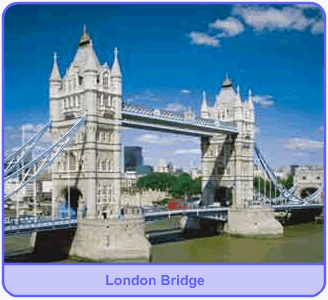
He reached London on 6th February. He found that he could not pass London Bridge, and for this reason he marched around London, through Richmond, Putney, through Kensington, and on to the Tower. He met with little resistance until he reached the Tower.
This diversion had given the newly appointed Earl of Pembroke plenty of time to prepare. Mary gave a rousing speech to the people of London, and they rallied behind her.
Wyatt found the city gates impenetrable, and the rebellion collapsed.
As with all rebellions it is difficult to pinpoint the real causes. It's hard to know what really motivated the rebels, and its leaders, as they often seem to hide behind their own propaganda.
According to P. Clark, there are three main reasons for the rebellion, and he stresses that all of them are local in origin:
Political
The marriage would mean the exclusion of certain political groups from power and this would have a knock-on effect on the customs of the land, thus affecting the commons.
Religious
Fear that Spanish resources would be used to increase the speed and ferocity of the Marian reaction.
Economic
Fears that with political changes there might be changes in land ownership.
These ideas are expanded on below:
Political Factors
The leaders were all knights from the Medway Valley area.
Many members of the gentry, who feared for their power and influence in the face of a Marian counter-reformation, wanted to put Elizabeth on the throne and have her marry Edward Courtenay. According to Fletcher and McCulloch, this was the main aim of the rebels. There are other historians who hold the view that the rebels would have forced Mary to cancel the marriage treaty and that was it.
Religious factors
There were many Protestants amongst the Kentish ranks. No doubt many of them were hostile towards Mary's religious policies as well as the marriage. There was a general consensus that the marriage would speed up the Marian reaction. (Indeed this was most probably Mary's plan!)
Many were Protestant in the manner that they preferred an erastian, secular kind of government, than religious. They were close to the Low countries, a geographical fact that was enhanced by the cloth trade. Many of the merchants were able to get their hands on Protestant literature, which they brought home and promulgated amongst their fellow men.
Maidstone had been at the centre of the Edwardian Reformation with its godly grammar school. Wyatt found most of his supporters from this area, and most of the Marian martyrs came from this area. Do we see a connection?
Also, there is evidence of Protestant supporters in the ranks, such as John Ponet, the Bishop of Rochester. Another churchman offered to sell his plate for Wyatt if he would restore the 'true religion'.
In private Wyatt made comments that his motives were religious: "we mind only the restitution of God's word".
Wyatt was considering taking his family into exile prior to the rebellion to avoid persecution - does this show how strong his Protestant convictions were?
After his arrest he greatly offended the Queen when he mocked the Catholic Easter service while in the tower.
But the 'Protestants' were not united as a group. In the period 1550-51 Wyatt had persecuted some Protestants who followed the teachings of Thomas Cole.
Economic Factors
During the reign of Edward, the Weald had suffered economically due to the decline of the cloth industry. There had been a period of falling demand for goods at home and a restriction on exports.
Nonetheless, the immediate circumstances before the rebellion had been quite positive: there had been a good harvest in 1553 and 53/54 had seen an upturn in the cloth trade. But the debts and rent arrears caused by the depression of the previous years had not been resolved.
Geographically, almost all of the leaders came from the Medway valley. The areas were urban, and if not exactly that, they were certainly involved in industry. (Maidstone, Rochester and Cranbrook, Pluckley, Ashford and Lenham.) These areas were cloth producing, and suffered from unemployment and vagrancy. Matters which had been exaggerated by disease. The merchants of the towns were probably very wary about the possible effects of Spanish competition on prices.
No real tenurial tie between the leaders and the followers in the rebellion. Seigneurial power was not as great in Kent as in other parts of the country. In fact, Wyatt a few years earlier had had an argument with his tenants. The tenants it seemed either followed or did not. Many of the rebels in fact came from magnates' lands when the Lord themselves did not rise. Pointing to grievances being of a landed nature, and perhaps in some way directed as much against their landlords as their monarch. (Not that these issues are raised in the 'Demands').
Initially, Mary looked as if she would take reprisals for the rebellion on a grand scale, but then her approach switched to one of leniency, possibly because of fears of further rebellion in the weeks before her marriage.
The control for the persecution of the rebels fell to the hands of William Paget. In all 480 were convicted; 90 were executed, after trial. Twenty of these were gentry leaders. Six hundred were pardoned.
⚠️ Image Coming Soon! - original image: a-his-midtub-dia01.gif
CSL Davies calls the accession of Mary Tudor "the only successful rebellion in Tudor England".
Mary became Queen despite:
Being barred from the throne by Edward VI's 'devices'.
The fact that council had consented to Jane Grey as Queen.
Northumberland's march on Suffolk (where she was staying).
An earlier kidnap attempt.
Mary's reception into the capital was no less than triumphant.
What did this mean? Did it mean that the people of London put legitimate succession above religious policy, or did they just have a sense of 'fair play' (N Heard).
Did the religious legislation of the previous twenty years mean nothing to them, or did they believe that Mary would not dare risk a complete counter-reformation?
For whatever reason the people of London, and elsewhere genuinely rejoiced at the arrival of their new Queen.
Somerset made agreements with, and probably bribed, councillors in to making him Protector of the realm. 1547 - 1549.
Somerset's main concern was foreign policy - all other policies followed from this. He put the crown into more debt during his protectorship.
Historians who like Somerset: M.L. Bush, A. Pollard, ST Bindoff (to an extent).
Historians who don't like Somerset: Dale Hoak, RW Heinz, Nigel Heard.
1549 saw many riots and two rebellions - The Western Rebellion, Ket's Rebellion.
The Western Rising was mainly directed against the new Book of Common Prayer, but there were other grievances.
Ket's Rebellion was a riot against the local landowners that was turned into a rebellion under the leadership of Robert Ket.
Northumberland quashed Ket's Rebellion - this gave him control of the army - which was instrumental in causing the downfall of Somerset.
Northumberland was Edward's principal councillor from 1549 - 1553.
This period's main characteristics are: peace with France, stabilisation of the economy, tighter control over the localities.
He fell in 1553, after backing his daughter-in-law's (Jane Grey) claim to the throne. (Traditionally seen as an ambitious plot by himself. Loades would disagree).
Mary was well received in London as the new Queen.
Her first priority was to secure a marriage. There were 3 contenders: Reginald Pole, Edward Courtenay, Prince Philip of Spain. She chose Philip.
The councillors were afraid for their own positions and made Philip sign a Marriage Treaty.
Fears of a Spanish invasion, and fears about the marriage in general, amongst other concerns sparked a rebellion early in 1554 - Wyatt's Rebellion. It involved the county of Kent. The rebels reached London. It was a major fright for the Queen and council.
Mary and Pole had a policy to re-catholicise England. They thought that it would be an easy job. They repealed the religious legislation of Edward's reign in 1553, and the Acts of Henry's reign in 1554. A new Treasons Act made it easy to prosecute 'heretics'.
Mary's rule saw 300 'heretics' burned at the stake, mostly on charges of possessing seditious literature. Most of the accused were from the SouthEast, especially Kent and Essex.
There is a historical debate surrounding the effectiveness of the counter-reformation.
Mary's foreign policy resulted in the loss of Calais. A major blow for England.
There are a number of factors why this rebellion failed. In your answer you should consider them all. Here are a few ideas. (Try to find evidence to substantiate them.)
Lack of coherent leadership.
Lack of aristocratic support.
Failure of the other three counties to rise.
Wyatt's own personal shortcomings.
Because the rebels delayed in attacking London.
The strength of Mary's support (especially after her speech to Londoners).
This is a really interesting question, and it gives you an opportunity to show off the amount of historiography that you know about the issue.
2. In what ways, if any, was Edward Seymour a 'good Duke'?
Here's your ideal opportunity to show off your historical awareness about how Somerset has been treated by historians in the past. If you cannot remember go back to the section on Somerset.
You could also define what exactly you think a 'good duke' was in the Tudor period. (If you can, try to show how contemporary perceptions of good leadership might have influenced historians who were writing in the nineteenth century, the early twentieth, the 60s, the 80s, and so on. This would take you up into the top band of the mark scheme showing that you can critically evaluate the ideas of historians.)
Discussion
Remember to demonstrate a balance here. It is important that you can find examples of him being a 'good duke' and examples of him not being such a good duke.
Conclusion
Sum up the main points of your argument and present your answer (that should have shown throughout your argument/discussion). There is also an opportunity to compare him to Northumberland (if you want).
For more information on structuring essays and how to use historiography go to the skills section.
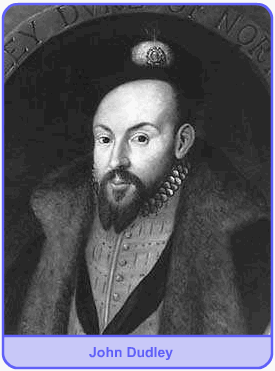
He was born in 1504. He was not a peer himself, but both his parents came from, or married into, noble families. His father was executed by Henry VIII on charges of treason (he was the Dudley of 'Epsom and Dudley'). His mother remarried, and the lands and peerage remained within the family.
He was knighted at the age of nineteen in honour of his fighting in France. He managed to create a fortune for himself through negotiations and squabbles over inheritance, on his own behalf, and on the behalf of his wife, a Guildford. He became Viscount Lisle in 1542. Soon after he became Warden General of the Scottish Marches and then Lord High Admiral in 1543. By Henry's death he was the 8th richest peer in the realm. He became the Earl of Warwick as soon as the regency council was assembled.
Like Somerset he had a reputation as a soldier. He had seen action in Scotland in the reign of Henry VIII, and under Somerset.
He was able to orchestrate the downfall of Somerset, with a number of other members of the council. He had the control of London on his return from Ket's Rebellion. Somerset's army was not accessible to him due to the Western Rising. Russell and Grey had been given orders to disband, but they did not. Instead, they retained their forces and declared their support for Warwick.
He showed incredible political dexterity in firstly winning over the conservative faction, by pretending to be a catholic sympathiser; and then he plotted with the reform faction. Not before long he had control of the council. He also managed to gain access to the King through Cranmer.
In a political about-turn, reminiscent of Cromwell in 1536, he expelled the conservatives from council, and became the Leader of the Council. By October he had acquired the title, and lands, of the Duke of Northumberland.
Northumberland was concerned with expenditure on the wars with France and Scotland. Wishing to make the crown more solvent, he knew that he would have to seek peace.
In 1549 France had openly declared war on England, taking full advantage of its domestic situation. Boulogne was under threat. Instead of putting more troops in to defend the port, he withdrew. The withdrawal from Boulogne was finalised in the Treaty of Boulogne, 1550. This action has been interpreted in different ways by historians. Some have seen it as a pragmatic move, the only sensible one in the circumstances, while others, like EN Williams, have seen it as act of subservience to France. A knock-on effect of this diplomatic move was that it scared the Holy Roman Empire, the last thing they wanted was an Anglo-French alliance directed against them.
The Anglo-French rapprochement was further enhanced by the betrothal of Edward VI and Elizabeth, the daughter of Henri II. (The marriage did not take place, as Elizabeth was ridiculously young.)
Traditional policy was reversed under Northumberland. There was an alliance with the 'natural enemy', and the Holy Roman Empire was isolated more and more.
Northumberland's personal religious convictions remain ambiguous. He may have been driven more by political expediency than by religious beliefs. He sided with the conservatives in 1549, but then dumped them in 1550. He tried to secure a Protestant succession in the form of Jane Grey in 1553, and yet, in the same year, just before his execution, he recanted his beliefs:
⚠️ Image Coming Soon! - original image: 2007-10-04_163311.gif
There was no major religious policy in these years, and Northumberland's policy may well have been to try to keep the peace, learning from the events of 1549.
In 1552 the Book of Common Prayer was re-issued, along with a second Act of Uniformity. This time people would be penalised for not adhering to the contents of the Act, or failing to use the new prayer book. There were no protests or demonstrations.
Northumberland's priority was peace in the realm. He realised, probably from the mistakes that Somerset made, that what England needed was a period of stabilisation. Consequently, he sought to have sound control over the Privy Council, and over the localities.
He purged the council of conservatives when he became Leader of the Council, but there was not a massive change of faces. Many of Somerset's allies had also been friends with Northumberland. Consequently, his colleague of old, Paget, and William Cecil stayed.
He secured his hold over central government by creating an inner council. Policy would sometimes by-pass the Privy Council, and be implemented by this council instead. This made some of the members of the Privy Council very wary about his intentions, but on the whole he worked harmoniously with council. He preferred to have military men in council, possibly because he knew that if there were another rebellion he would have men and arms at the ready.
He preferred not to use proclamations. He made use of parliament.
As one of his first measures he sent the Lords Lieutenant out of court and back to their localities, thus ensuring that there was a member of the government's executive in all the regions of the kingdom.
Northumberland inherited a dire financial and economic situation.
Although we can't really call him a long-term planner, he did appear to have foresight in a way that his predecessor did not. He undertook a number of measures to try to increase the crown's revenue and stabilise the economy:
Cecil was put in charge of the treasury with the task of sorting out the crown's finances.
Gresham was sent to the Netherlands to negotiate with the Flemish cloth traders and foreign bankers. He met with some success.
In 1552 the council established a commission to investigate the revenue system.
In March 1552 the coinage was called in and reminted at its 1527 value, thus putting an end to the debasement of the coinage, and going some way to combating inflation.
He repealed the tax on sheep.
He reduced spending on foreign policy.
In his three and a bit years in office he managed to reduce the crown's debt from £260 000 to £180 000.
David Loades writes, "Northumberland was defeated by a cruel twist of fate." Others would argue that he fell because of his unrealistic ambition.
In 1553 it became obvious that the king was dying. No one had seen it coming; the king was only a couple of years off his majority. Northumberland had become increasingly unpopular at court in his attempts to secure the king's favour.
Edward had made provisions for his death in January 1553. In his 'devise' he ignored statute law (Henry VIII's will) and instead he formulated his own succession policy. The crown should pass down the Brandon side of the Tudor family in the event of his death. This made the heir to the throne, Edward's cousin, Frances Grey. Loades would argue that this piece of legislation was the sole work of Edward, but there are many others who see the hands of Northumberland and Cranmer at work.
However, when Edward was very ill the 'devise' was changed in favour of Frances Grey's daughter, Jane Grey, who just happened to be married to Northumberland's son, Guildford Dudley. To be fair there were a number of reasons why Edward would have wished for her to succeed him: she was Protestant, she shared the same schooling as he did, she was a good friend, and she was married to an English nobleman.
Thus when Edward died in the evening of 6th July 1553, Jane Grey was proclaimed Queen of England. The council was mute on the matter. After all, it was treason to question the king's decision. But Mary was on the move. She had the full support of the East Anglian gentry (although only one nobleman backed her). She proclaimed herself Queen at Framlington Castle. Northumberland had a decision to make, and he had to make it fast. Should he declare for the Queen in London, or stand for Jane Grey and march troops up to Suffolk? On the 14th July he marched 2 000 men to Suffolk, but they deserted him en route.
The Privy Council declared for Mary, and Northumberland was arrested in Cambridge. He was executed on 22nd August 1553 along with his son and his unfortunate daughter-in-law.
In the past Northumberland has had a poor press. He has, traditionally, been seen as the 'Evil Duke' (cf. Somerset as the 'Good Duke'). However, Dale Hoak in his Rehabilitation of the Duke of Northumberland has done a lot to remedy this.
Nigel Heard has a balanced view: "While Northumberland did little to resolve the underlying economic problems, he did check inflation, and ease the worse of the social distress."
Lotherington: "a genuine and able reformer"
Nevertheless, he still is the man that historians love to hate:
Jennifer Loach maintained that he was 'greedy' and 'ambitious'.
WRD Jones has him as a devious plotter of plots and counter-coups.
The tone of the demands of the Norfolk rebels was very different to that of the Western Rebels. They began their petition with the words, "we pray your grace". There was no "we will have!"
There were 29 Articles in all, and off these thirteen were agricultural and seven were anti-clerical. There were also articles protesting against the local lords.
The Articles including the following:
No Lord should pasture animals on the commons (a reference to an effect of enclosure).
Rent prices of copyhold land, meadowland and the marshes should be set at the 1485 level.
Land that was held in freehold should not be converted to copyhold.
No man worth £401 or over a year to keep cattle or sheep except for their own subsistence. (A direct attack on gentlemen farmers).
The political roles of priests and vicars should be limited in the towns and the villages.
Lower the tax levied on the inheritance of the land.
If priests or vicars earn above £10 a year they should teach the poorer children.
Secured rights for fishermen.
Parishioners should have the right to choose their own priests.
These articles were signed by Robert Ket, Thomas Cod and Thomas Aldryche.
Northumberland used martial law to deal with the rebels. He hanged any that he could get his hands on during the siege of Norwich. After the battle he continued his rule of the area in this arbitrary way, and as many as 250 were hanged without trial after the rebellion.
Somerset was humiliated by both the rebellion in Norfolk and the rebellion in the West country. He was seen as weak in his approach to the rebels. In contrast, Warwick appeared extremely firm (if not ruthless).
Warwick was able to march back to London in control of the army. Consequently, when he reached London on 14th September, he was in control of the city. This heralded the downfall of Somerset. Did Dudley plan it?