
WHAT YOU'LL LEARN
The Reichstag Fire and the Enabling Act
Hitler became Chancellor on 30 January 1933 - but he was not yet a dictator. Germany was still a parliamentary democracy (just). Within six months, it would be a one-party state. The transformation happened with startling speed, and two events above all made it possible: the Reichstag Fire of 27 February 1933, which allowed Hitler to suspend civil liberties under emergency powers; and the Enabling Act of 23 March 1933, which gave him the right to govern without the Reichstag. Together, these two events ended the Weimar Republic and began the Third Reich.
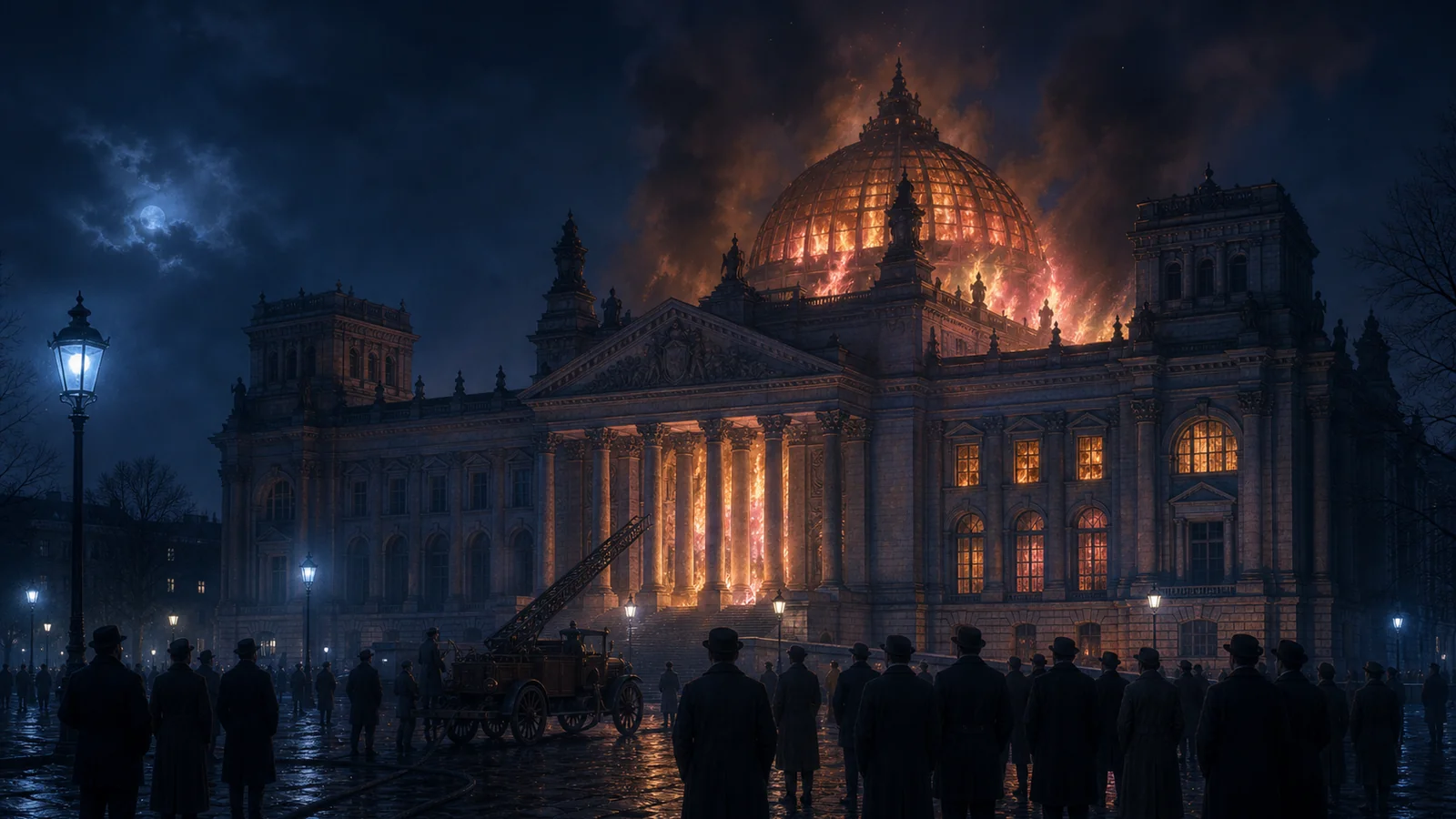
The Reichstag Fire, 27 February 1933
Less than a month after Hitler's appointment, the Reichstag building - Germany's parliament - was set on fire. A young Dutch communist, Marinus van der Lubbe, was caught inside with firelighting materials. He was arrested and later executed.
The Nazis immediately declared the fire a Communist plot - the beginning of a communist revolution to overthrow the government. Whether they believed this, or whether (as many historians have suspected) the Nazis themselves set the fire or exploited it with prior knowledge, remains debated. What is certain is that they exploited it with extraordinary speed.
Within 24 hours, Hitler had persuaded Hindenburg to sign the Reichstag Fire Decree (also called the "Emergency Decree for the Protection of the People and the State"):
- Civil liberties were suspended: freedom of speech, freedom of the press, freedom of assembly
- The police were given powers to search and detain without warrant
- The death penalty was introduced for a wide range of offences
Over the following days, more than 4,000 Communist and Social Democrat politicians and activists were arrested. The KPD - the Communist party - was effectively destroyed as a political force before the elections scheduled for 5 March.
Historical debate
Who started the Reichstag Fire?
Van der Lubbe confessed to acting alone, and this is now the most widely accepted view among historians. But the timing - just weeks after Hitler's appointment, at the most politically convenient moment imaginable - has long generated suspicion. Hermann Göring, who was present that night, was accused at Nuremberg of knowing about the fire in advance. For the AQA exam, the important point is not who set the fire but how Hitler used it: the Reichstag Fire Decree suspended civil liberties and enabled mass arrests of opponents before the election. Whether planned or opportunistic, the result was the same.
The March 1933 elections
Even with 4,000 opponents arrested and civil liberties suspended, the Nazis did not win an outright majority in the election of 5 March 1933. They received 43.9% of the vote - their highest total in a free election - but still needed coalition partners to govern.
The SA intimidated voters and disrupted opposition campaigning. Goebbels' propaganda machine ran at full intensity. Yet 56% of Germans voted against the Nazis. Hitler did not have a democratic mandate for dictatorship.
The Enabling Act, 23 March 1933
To govern without the Reichstag, Hitler needed to pass the Enabling Act - technically the "Law for Removing the Distress of the People and the Reich." This required a two-thirds majority in the Reichstag to change the constitution.
To secure this supermajority:
- The 81 Communist deputies could not vote: they had been arrested or had fled
- The Centre Party (the main Catholic party) was persuaded to vote in favour after Hitler gave personal assurances (which he would never keep) that he would protect Catholic institutions
- Social Democrats were the only party to vote against
On 23 March 1933, with SA men ringing the Kroll Opera House where the Reichstag temporarily met, the vote was taken: 444 in favour, 94 against (all Social Democrats). The Enabling Act passed.
Hitler now had the power to pass laws without the Reichstag, without the President, and without the courts. The Weimar Republic was dead.
Key speech
Otto Wels addresses the Reichstag, 23 March 1933
**Otto Wels**, leader of the Social Democrats, gave the only speech opposing the Enabling Act. Surrounded by SA men, knowing he risked arrest, he declared: "We German Social Democrats pledge ourselves solemnly in this historic hour to the principles of humanity and justice, of freedom and socialism. No enabling act gives you power to destroy ideas which are eternal and indestructible." Hitler's contemptuous response dismissed him. Wels fled Germany shortly after. He died in Paris in 1939. For the exam, Wels's speech is significant as evidence of democratic resistance - and its futility.
The elimination of all other parties
Within months of the Enabling Act, the one-party state was complete:
- May 1933: Trade unions dissolved; their offices seized by the SA; union leaders arrested
- June 1933: The Social Democrats banned
- July 1933: All other political parties dissolved or "voluntarily" liquidated - including the Centre Party that had voted for the Enabling Act
By 14 July 1933, Germany was officially a one-party state. A law passed on that date made it illegal to form a new political party.
The Weimar Republic - founded in 1919 - had lasted fourteen years. The Third Reich, Hitler promised, would last a thousand.
Why this matters for the exam
How did Hitler establish a dictatorship so quickly?
AQA often asks how Hitler was able to establish a dictatorship so rapidly after becoming Chancellor. Key steps: (1) Reichstag Fire Decree - suspended civil liberties; (2) mass arrests of opponents before the March election; (3) Enabling Act - legal power to bypass parliament; (4) banning of opposition parties. A strong answer should emphasise that the process was fast (six months), used legal mechanisms (the Enabling Act was a constitutional amendment), and that opponents - including those who had voted for the Enabling Act - were then destroyed anyway. "Legal" dictatorship was still dictatorship.
Revision checklist
Before moving on, make sure you can answer:
- When and how did the Reichstag Fire happen? Who was arrested?
- What was the Reichstag Fire Decree? What powers did it give the government?
- What happened in the elections of 5 March 1933? Did the Nazis win a majority?
- What was the Enabling Act? Why did Hitler need a two-thirds majority to pass it?
- How did the Centre Party end up voting for the Enabling Act?
- What did Otto Wels do on 23 March 1933? What happened to him?
- By July 1933, Germany was a one-party state. How had this happened in just six months?
- How did Hitler use "legal" means to establish his dictatorship?
What's New snippet
Article slug: gcse-history-germany-reichstag-fire-enabling-act
Title: From democracy to dictatorship in 53 days - the Reichstag Fire and the Enabling Act
On 27 February 1933, the Reichstag building burned. By 23 March, Hitler had used the emergency to push through the Enabling Act - giving himself the power to rule by decree without Parliament. Germany went from a democracy to a one-party state in under two months. This page traces exactly how it happened, step by step.