
WHAT YOU'LL LEARN
The Early Nazi Party and the Munich Putsch
In November 1923, Adolf Hitler stood in a Munich beer hall and declared a national revolution. Two days later it was over: sixteen Nazis were dead, Hitler was under arrest, and the whole attempt looked like a humiliating failure. But that failure turned out to matter more than any success could have. What happened in Munich – and why did it change everything that came after?
How did the Nazi Party begin?
The Nazi Party did not start as the Nazi Party. In January 1919 – the same month as the Spartacist Uprising in Berlin – a small group of nationalists in Munich formed the German Workers' Party (Deutsche Arbeiterpartei, or DAP). It was one of dozens of similar far-right groups that sprang up in postwar Germany, sharing a common conviction: that Germany had not really been defeated in 1918 but had been "stabbed in the back" by socialists, Jews, and traitors on the home front.
Adolf Hitler – a failed artist and decorated war veteran who had been profoundly shaken by Germany's defeat – joined the DAP in September 1919. He quickly became its most effective speaker. His speeches at Munich beer halls drew hundreds, then thousands, of listeners. He had an unusual gift: the ability to take the grievances, humiliations, and hatreds that many Germans felt and give them a clear narrative, a clear enemy, and a clear promise of revenge.
In 1920, the party renamed itself the National Socialist German Workers' Party (Nationalsozialistische Deutsche Arbeiterpartei, or NSDAP) – the Nazi Party. The same year, Hitler and fellow party member Anton Drexler published the 25 Points Programme, which set out the party's core beliefs.
Key term
The NSDAP (Nazi Party)
The National Socialist German Workers' Party combined nationalist and socialist-sounding language to appeal broadly. Its 25 Points Programme rejected the Treaty of Versailles, demanded the unification of all German-speaking people into one state, called for the removal of Jewish people from German citizenship, and promised land redistribution and the nationalisation of large businesses. Despite the "workers' party" label, the Nazis never seriously pursued socialist economics – the socialist elements were dropped once the party gained power. The name was a political strategy, not an ideological commitment.
By 1923, the Nazi Party had around 55,000 members, mostly concentrated in Bavaria. It remained a regional movement – but its leader had national ambitions.
What was the SA – and what role did it play?
Hitler understood early that political meetings were not enough. The Weimar Republic's streets were violent places: communist groups, nationalist organisations, and veterans' associations all used physical intimidation as a political tool. The Nazis needed their own muscle.
Key concept
The SA (Sturmabteilung)
Formed in 1921, the SA – also known as the Brownshirts or Stormtroopers – was the Nazi Party's paramilitary wing. Led initially by Ernst Röhm, a veteran soldier with extensive military contacts, the SA provided physical security for Nazi meetings, broke up meetings of rival parties, and served as a visible symbol of Nazi organisation and strength. For many disillusioned veterans, the SA offered comradeship, discipline, and purpose – things the Weimar Republic could not provide. By the early 1930s the SA had hundreds of thousands of members. Its role, and Röhm's ambitions for it, would eventually lead to his death in the Night of the Long Knives in 1934.
The SA intimidated opponents, protected Hitler's meetings from disruption, and gave the Nazi movement the appearance of a disciplined force capable of taking action. At a time when many Germans felt the Weimar government was weak and indecisive, this image had real appeal – especially to unemployed veterans who felt the republic had abandoned them.
What was the Munich Putsch – and why did Hitler attempt it?
Key individual
Adolf Hitler (1889–1945)
Hitler was born in Austria and served in the German army during the First World War, winning the Iron Cross twice. He experienced Germany's defeat in November 1918 while recovering from a gas attack – and was, by his own account, devastated. He joined the DAP in 1919 and quickly dominated it through his skills as a public speaker and his willingness to be radical where other politicians hedged. The Munich Putsch was his first attempt to seize power by force. After its failure, he changed strategy entirely – deciding to use elections rather than armed revolt to reach power. That change of strategy, made in a prison cell, would eventually succeed.
By October 1923, Germany was in the deepest crisis of the republic's short life. Hyperinflation had destroyed the currency. France occupied the Ruhr. The government in Berlin – in Hitler's view – was humiliating Germany at every turn. And across Europe, Mussolini had just seized power in Italy with his "March on Rome" in 1922, showing that armed takeovers were possible.
Hitler decided to act. His plan – ambitious, poorly organised, and ultimately naive – was to seize power in Bavaria first, then march on Berlin and overthrow the Weimar government, as Mussolini had marched on Rome. He had the support of Erich Ludendorff, the famous First World War general, which he believed would guarantee the army's support.
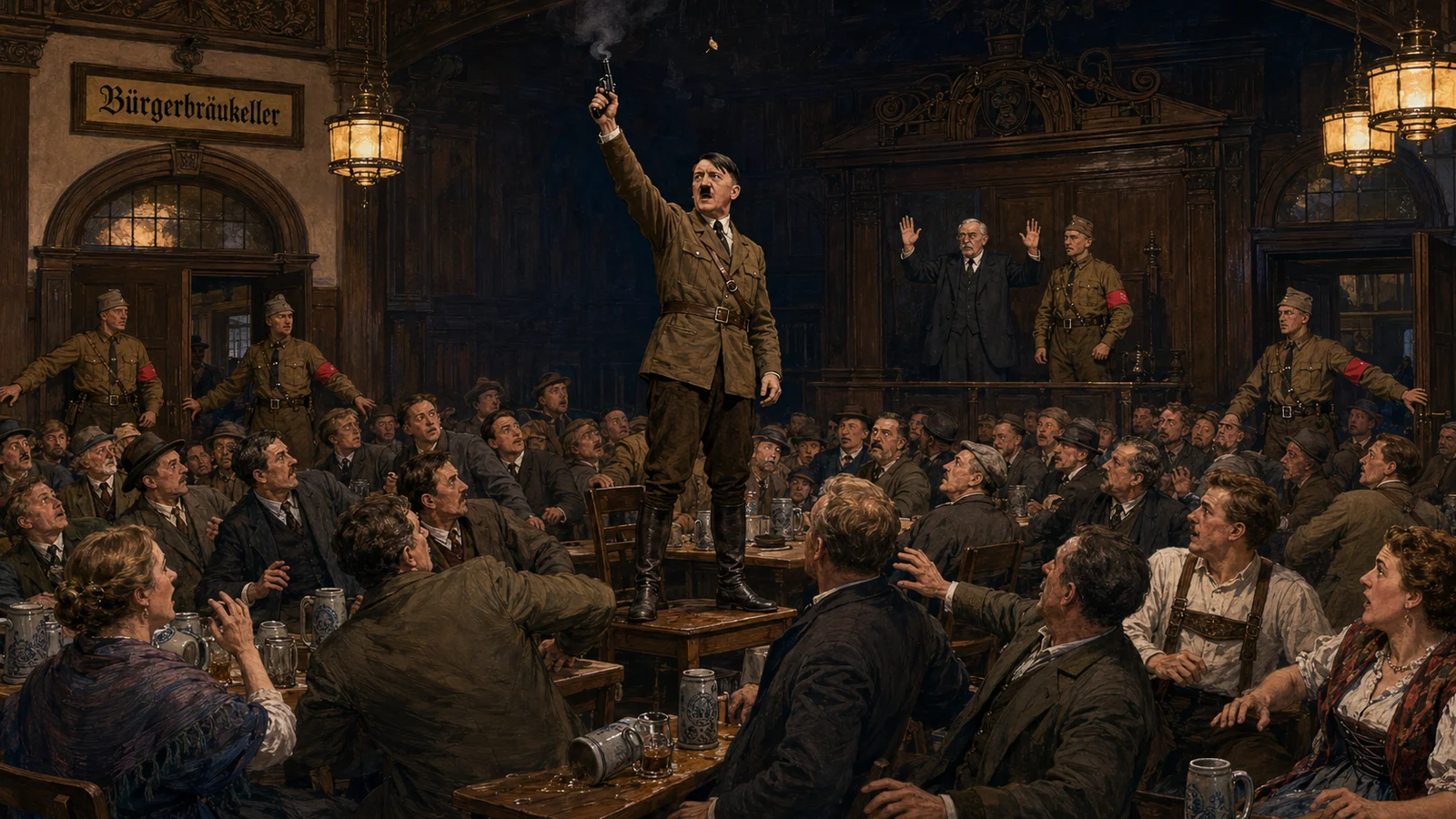
On the evening of 8 November 1923, Hitler's SA men surrounded the Bürgerbräukeller, a large beer hall in Munich where the Bavarian State Commissioner, Gustav von Kahr, was addressing a meeting. Hitler burst in, fired a pistol into the ceiling, and declared the national revolution had begun. He announced that the Bavarian government had been overthrown and forced Kahr at gunpoint to give his support.
The support, it turned out, was given at gunpoint and not meant. As soon as Kahr was released, he contacted the police and army and withdrew his endorsement. The next day, 9 November 1923, Hitler and Ludendorff led around 2,000 Nazis through Munich towards the city centre. At the Odeonsplatz, they were met by a cordon of armed police. Shots were fired. Sixteen Nazis and four police officers were killed. Hitler fled. He was arrested two days later and charged with treason.
Why did the putsch fail – and why did the failure matter?
The putsch failed for several straightforward reasons. Hitler had misjudged the willingness of Bavaria's conservative leaders to join a revolution against Berlin. He had assumed the army would side with him – it did not. He had overestimated his own position: in 1923, he was a regional agitator, not a national figure.
The consequences of failure, however, were not what might have been expected. Hitler was tried for treason and received a sentence of five years in Landsberg Prison – but served only nine months before being released on parole. The lenient sentence reflected the fact that the judges were sympathetic to nationalist politics, even if they could not ignore the law entirely.
During his time in Landsberg, Hitler dictated the first volume of Mein Kampf (My Struggle) – a combination of autobiography, political programme, and racial ideology that laid out his worldview in full. Crucially, he also revised his strategy. Armed revolt had failed. The Weimar Republic had survived the crisis of 1923 and was beginning, under Stresemann, to stabilise. If the Nazis were going to come to power, they would have to do it through elections – through winning enough votes to enter and then control the government.
That decision, made in a prison cell in 1924, determined how the Nazis would operate for the next nine years.
The examiner's test: A student who can describe the Munich Putsch earns basic marks. A student who explains why the failure of the putsch led Hitler to change strategy – and why that new strategy, using democracy against itself, was ultimately more dangerous than any armed uprising – earns the higher marks. The putsch failed; the lessons Hitler drew from it succeeded.
Summary Card
If you remember three things about the early Nazi Party and the Munich Putsch, remember these.
- The Nazi Party grew from a small Munich fringe group (the DAP, founded 1919) into a 55,000-member movement by 1923, built on Hitler's skills as a speaker and the SA's capacity for organised intimidation. The 25 Points Programme gave the party a clear platform: anti-Versailles, anti-communist, anti-Semitic, and nationalist. In your exam, the specific detail that matters is the chain: DAP → NSDAP → 25 Points → SA → Munich Putsch.
- The Munich Putsch of 8-9 November 1923 was a failed attempt by Hitler to seize power in Bavaria and march on Berlin. It was modelled on Mussolini's successful March on Rome (1922) but relied on support from Bavarian leaders who withdrew it as soon as they were free to do so. Sixteen Nazis were killed. Hitler was arrested and tried for treason.
- The failure of the putsch changed Hitler's strategy entirely. Sentenced to five years but released after nine months, Hitler concluded that armed revolt could not succeed against a functioning state. He would use elections instead – winning power through the ballot box by exploiting the democratic system the Nazis despised. That decision, made in Landsberg Prison, is the turning point that connects 1923 to 1933.
Memory hook: Found the party → Built the SA → Tried the putsch → Changed the strategy. Four steps from beer hall speeches to the decision that made 1933 possible.
Revision checklist
Before moving on, make sure you can answer:
- How did the German Workers' Party (DAP) become the Nazi Party (NSDAP), and what did the 25 Points Programme demand?
- What was the SA, and why was it important to the early Nazi movement?
- What were Hitler's plans for the Munich Putsch – and why did they fail?
- What was Hitler's sentence for treason, and how did he use his time in prison?
- How did the failure of the Munich Putsch change Hitler's political strategy?