
WHAT YOU'LL LEARN
Creating a Dictatorship: the Police State, SS and Gestapo
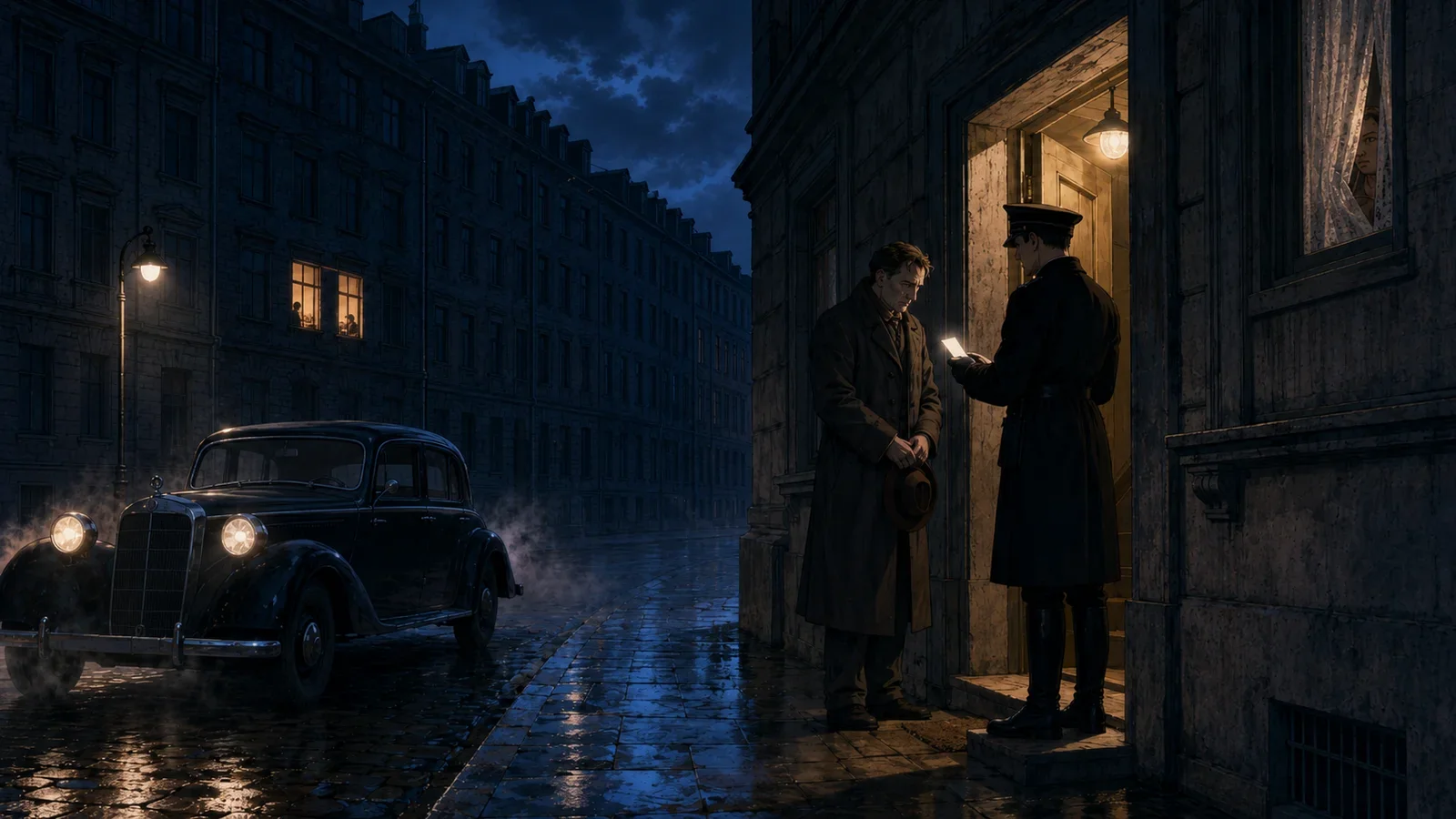
The Nazi regime maintained its grip on Germany through a combination of surveillance, fear, and the systematic removal of legal protections. The SS, the Gestapo, concentration camps, and a judiciary that served the state rather than the law were the instruments of this control. But historians have also discovered something more disturbing: the regime relied not only on terror but on genuine popular consent and, critically, on ordinary people informing on their neighbours. The Nazi police state worked as much through cooperation as through coercion.
The SS: Himmler's empire
The SS (Schutzstaffel - "Protection Squad") began as Hitler's personal bodyguard, founded in 1925. Under Heinrich Himmler, who took control in 1929, it was transformed into one of the most powerful organisations in Nazi Germany.
By 1933 the SS had around 50,000 members. By 1939 it had over 250,000. By 1945, with its military wing (the Waffen-SS) included, it numbered in the millions.
The SS was elite in the Nazi hierarchy - members were required to prove "racial purity" going back several generations. They were expected to embody Nazi ideology in their personal and professional lives. But their power derived above all from their institutional control: by 1936, Himmler controlled all German police forces, making the SS effectively a state within the state.
Key SS functions:
- Guarding concentration camps (the Totenkopf - "Death's Head" units)
- Carrying out racial policy, including the Holocaust
- Running the SD (Sicherheitsdienst - the SS intelligence service)
- Policing the regime itself: Himmler's men watched for disloyalty even among senior Nazis
Key individual
Heinrich Himmler (1900–1945)
Himmler was one of the most powerful men in Nazi Germany and the primary architect of the Holocaust. A former chicken farmer with an obsessive belief in racial pseudo-science, he built the SS from a personal bodyguard into a vast empire spanning police, intelligence, concentration camps, and military units. He was meticulous, bureaucratic, and capable of organising mass murder on an industrial scale while presenting himself as a respectable administrator. He was captured by the British in May 1945 and killed himself before he could be tried at Nuremberg.
The Gestapo: the secret police
The Gestapo (Geheime Staatspolizei - Secret State Police) was founded in Prussia in 1933 by Hermann Göring, then taken over by Himmler in 1936 and merged into the SS apparatus.
The Gestapo's job was to identify, investigate, and destroy opposition to the Nazi regime. It operated without legal constraints: it could arrest, imprison, and torture without judicial oversight. Those it detained could be sent directly to concentration camps without trial.
How effective was the Gestapo? For decades, historians assumed it was an omniscient surveillance machine - that every German conversation was monitored, that informers were everywhere. More recent research has revised this: the Gestapo was actually surprisingly small (around 32,000 agents for a country of 80 million people). It was effective not because of its size but because of denunciations - ordinary Germans informing on their neighbours, colleagues, and sometimes family members.
Historical insight
Denunciations and the willing informer
Historian Robert Gellately's research found that the vast majority of Gestapo cases were initiated not by the Gestapo itself but by ordinary Germans who chose to report their neighbours, colleagues, and acquaintances to the authorities. Some did so for ideological reasons (genuine Nazis); many did so for personal reasons (settling scores with neighbours, getting rid of business competitors, ending unwanted relationships). The Gestapo was effective because Germans informed on each other. This has led historians to revise upward their assessment of the degree to which the Nazi system depended on popular participation rather than pure external coercion.
Concentration camps
The first concentration camps were established within months of Hitler becoming Chancellor. Initially they were used to imprison political opponents - Communists, Social Democrats, trade union leaders - rather than Jews (though Jews were targeted from the beginning for other forms of persecution).
Dachau, near Munich, was opened in March 1933 - less than two months after Hitler's appointment. It became the model for subsequent camps: forced labour, brutal discipline, psychological humiliation, and deliberate starvation.
Between 1933 and 1939, the concentration camp system expanded. Inmates included political prisoners, "asocials" (a catch-all category including Roma, gay men, the homeless, and those the regime deemed workshy), Jehovah's Witnesses, and increasing numbers of Jews following the Kristallnacht pogrom of November 1938.
The wartime extermination camps - where systematic mass murder took place - were distinct from the pre-war concentration camps, though the earlier system provided the institutional framework and personnel.
The courts and the law
One of the most important features of Nazi rule was the destruction of an independent judiciary. Under Weimar, courts had been broadly independent. Under the Nazis, judges were required to deliver verdicts that served the state's interests.
In 1934, a People's Court (Volksgerichtshof) was established to try cases of treason - effectively any opposition to the regime. Its judges were reliable Nazis; defendants had minimal rights; the sentences were almost uniformly severe.
Why this matters for the exam
Terror vs consent in the Nazi state
AQA questions about the Nazi police state often ask how it maintained control. A sophisticated answer distinguishes between coercion (the SS, Gestapo, concentration camps, corrupted courts) and consent (propaganda working effectively, genuine popularity of economic recovery and national prestige, ordinary Germans participating through denunciations). The most credible historical view is that the Nazi regime used both, and that consent was more widespread than many post-war Germans wished to admit. Most Germans were not actively opposed to the regime; many actively supported it; and the minority who opposed it did so at enormous risk.
Revision checklist
Before moving on, make sure you can answer:
- What was the SS? Who led it, and how did it change under his leadership?
- What was the Gestapo? Who created it and who controlled it?
- How large was the Gestapo? Why was it effective despite its relatively small size?
- What were denunciations? Why are they historically significant?
- When was the first concentration camp opened? Who were the early inmates?
- How did the Nazis change the court system? What was the People's Court?
- What is the difference between coercion and consent in explaining how the Nazi regime maintained control?
- Overall, how did the Nazi police state work? What were its key features?
What's New snippet
Article slug: gcse-history-germany-police-state-ss-gestapo
Title: Watching, informing, disappearing - how Nazi Germany's terror state worked
The Nazi police state wasn't sustained by an army of secret agents - it was sustained by ordinary Germans who informed on their neighbours, colleagues, and family members. The Gestapo had only around 32,000 agents to monitor millions of people; denunciations did the rest. This page covers the SS, the Gestapo, and the concentration camp system.