
From Newton's Second Law and the definition of force:
(mv = final momentum, mu = initial momentum)
So, Ft = mv - mu
But, mv - mu = change in momentum
We call change in momentum impulse.
Impulse = Change in momentum = Ft
Units: Ns or Kgm/s
To achieve any particular change in momentum, you can either have a large force multiplied by a small time or a small force multiplied by a large time.
This explains how crumple zones work!
Volvo cars love collisions so much that they have crumple zones which make the collisions last longer. A longer time means that you can achieve the same change in momentum during a collision by applying a smaller force. And it is the force that hurts the passengers.
We can plot graphs of the force during a collision against time.
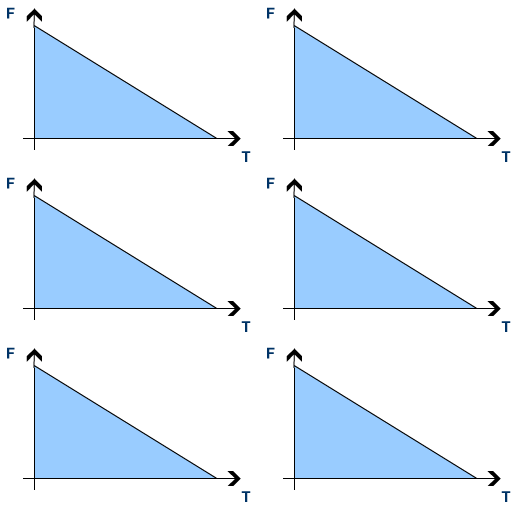
We can find the impulse, or change in the momentum, by calculating the area under the force-time graph.
Question:.
A car of mass 1000 kg is travelling at 40 m/s when it collides with a wall. The passenger can only survive when the maximum force on the car is 20 000 N.
/**/